Episode 64 · June 25, 2026
Zach Goldstein
Founder/CEO · Thanx
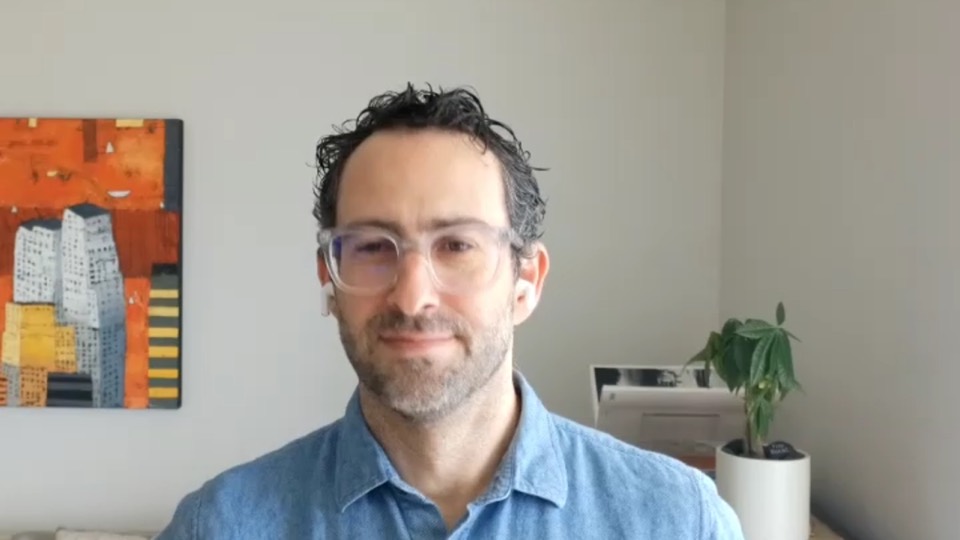
Zach Goldstein, Founder/CEO at Thanx, is the guest on episode 64 of the Restaurant Tech Trends podcast, hosted by Justin Foster.
 Play episode
What Zach and Justin discuss
- Zach's take on the SaaSpocalypse and what actually makes software defensible
- Where AI is REALLY changing loyalty plus the three bets Thanx is all-in on. HINT: big news this summer...
- The digital ratio every operator should track and why letting third-party marketplaces outgrow your first-party channels means losing your guests AND your data
Also in this episode
- The "warm hug vs. $7 discount" psychology of changing guest behavior, and why loyalty may be a restaurant's best weapon to steer the coming wave of AI ordering agents back to first-party
- Rapid fire - the most OVERRATED restaurant tech (you'll never guess this one), the most underrated, his one-word advice to 2011 Zach, and whether the Sacramento Kings are making the playoffs next season
Episode notes from the host
Own the guest relationship or get rented out to the highest bidder.
That's part of what we dive into on today's Restaurant Tech Trends. On this episode I sit down with Zach Goldstein, Founder & CEO of Thanx. Zach has helped restaurants turn first party data into lifetime value since 2011. Watch for a masterclass in loyalty, data, and how AI agents are transforming the guest retention game.
Thank you Zach for the clinic on loyalty and LTV!
Transcript
Full transcript (5,215 words)
Machine-generated transcript; names may be misspelled.
0:00 Hey everyone, welcome to Restaurant Tech Trends where we explore restaurant technology trends with some of the industry's biggest movers and shakers in a rapid fire short interview format. This podcast is produced by Incept AI. Incept AI takes restaurant orders over the phone and in noisy drive-thrus with friendliness and precision. Learn more at Incept.ai. My guest today has spent his career chasing one question. Why do customers like this? Come back. Zach Goldstein is the founder and CEO of Thanx, the guest engagement and loyalty platform he launched in 2011 to help restaurants turn first party data into lifetime value. Before Thanx, he sharpened his loyalty thinking at Bain and earned his MBA at Stanford. Smart dude. He's also one of the loudest voices in the space as the author of Four Horsemen of the Restaurant Apocalypse. Zach, welcome to the show. Pleasure to be here. Thanks, Justin. Glad to have you on here. Gonna learn all about loyalty today. Learn all about Thanx. But before we get there, take us back to 2011. You were a Bain consultant turned Stanford MBA. What did you see in the market that made you say, I'm going to build a loyalty company? And what was the very first version of Thanx actually like?
1:22 Yeah, there were two trends happening then that really bothered me and I think any good founding story has something that you're just kind of irrationally passionate about. For me, it was the prevalence and growth of data. You know, people were talking about data is the new oil that's everywhere. But offline businesses, not just restaurants, but all offline businesses, services, businesses and retailers were severely lacking in that data. That bothered me. The second is this was the era of a little bit after Groupon. Yeah, and all the attention and dollars were going into customer acquisition. And yet, when you look at most successful businesses, it's a lot more focused on customer lifetime value. And so that represented a problem that needed to be solved in my mind. Restaurants are a massive industry that was that was doing that were at the time, and in many ways, I think still are though much better struggling with what do I do to capture and utilize data and how do I drive lifetime value and those remain our North Star at Thanx, but those are the problems that I locked up into and thought this must. This must, this must be solved. And here we are today.
2:38 So when you take a look back at your founding thesis for the company, how much of that has actually held up today versus, you know, what have you had to throw out? The core North Star that restaurants or any business need to understand their customers and rather where their revenue is coming from and need to be able to drive lifetime value. Yeah. Untouched. Perfectly true today as it was a decade plus ago. The path to getting there has changed rapidly right in the middle of that period was the arrival of third party marketplaces, which I have talked extensively about. I think it's a large, most significant disruption that the restaurant industry has ever seen. I think we are still in fairly early innings of that disruption, even five years post COVID, call it fifth or sixth inning. So there's still more to that story. And what that did and what COVID did specifically is rapid rapidly digitize the restaurant industry. Yeah. And so we see a lot of revenue now coming from digital channels, whether those are third party marketplaces or first party or in store kiosks or table side ordering, et cetera voice, of course. And that's a huge step forward on ways to capture more revenue.
4:01 Of course, third party marketplaces are a material chunk of most restaurants business now. Yeah. But it's also a massive acceleration in data. And that means that now it's more important than ever that winners capture and utilize that data to their advantage. And so the last thing I'd say is store location, great product was probably enough for a while, 10, 20 years ago to run a great restaurant. And now just as important on that list is do you have strong digital channels and are you utilizing the data that you're capturing to drive repeat purchasing? I definitely want to spend a little bit of time a little bit later on talking about the third party marketplaces and getting access to some of that data, because the data is a lot of the data is a lot of the data. Because that has been a big challenge for a lot of operators, even today. But before we get there, you know, whenever I have a founder on this podcast, every founder knows building a business is never like just straight up to the right. There's bumps along the way. And I would like to hear about some of those bumps in Thanx's story. Did you ever have like a near death moment or like a stretch that was particularly hard? And how were you able to get the business through that patch?
5:17 We've had plenty of near death moments and stretches that were hard. I described the story of being a founder as like at any given moment, you feel like everything's falling apart because the good things happen in these massive step functions, but the bad things just kind of slowly eat away at you. I'll describe one specific transition that we made as a business. I had a vision that was that was pretty grandiose when starting Thanx. I wanted to solve that data and lifetime value problem, not just for restaurants, but for everyone. And I wanted to do it for every business, no matter how small or how large. And that dream is was it was at the core of the mission that I felt like we were on. And that can be very powerful for me, at least as a founder. But I think for lots of founders to feel like you've got a you've got a goal, a calling. And for investors to do right sexy story. For sure. Right, like that makes a big market opportunity. The problem was that is exceedingly difficult to do with that many different customer profiles at different sizes. And anyone that has sold into S&Bs, small, medium sized business, knows that that can be very challenging because in any small and medium sized businesses are focused on the day to day, because they have to be and anyone that sold across verticals knows that while they're tantalizingly similar a restaurant and a car wash they're notably different in ways and they need to be treated differently.
6:57 And so we really had to narrow our focus to where our solution was most valuable and that ultimately ended up being mid market emerging enterprise and enterprise restaurants specifically, which is where we focus today. It still pains me that I and that we at Thanx aren't currently able to support the huge swath of one to location operate restaurant operators that are. I think the fuel and the lifeblood of our economy and our and our culture. I hope to get back there in the future, but at the time we had to we had to pivot the business and that resulted in changing the structure of our team that resulted in. Narrowing our focus on that vision and dream. It's been healthy for our customers. It's been healthy for us, but it took some staring at a wall and sleepless nights for me. You know, it's crazy to when you think about once you start solving a problem, you discover the thousands of little edge cases in weird ways that customers use your product that really don't translate directly from one vertical to another vertical market. I definitely I mean, we had dealt with the same thing, right? And we were starting the company.
8:12 It's like, hey, you know, you've got the solution. Why don't you just offer it to like call centers or why don't you offer it in like logistics or health care? And it's just like focus can be so important when you're kind of in that scaling up phase. So it's interesting to see that you guys sort of came to that same conclusion. Let's skip forward and talk a little bit more about today and what's going on with Thanx. There's a lot that's going on right now in the industry on the data side. Obviously, AI is like the hot thing in our industry and really all industries right now. You guys lean very heavily on data and AI to segment and target customers. And as a person that's really been building this for over a decade, tell us a bit more about where AI is actually changing loyalty right now. Like, what are you actually using AI for to drive higher loyalty, greater lifetime value? And where is it just kind of like we're still in the hype or the buzzword phase? Yeah, there are three applications that we are focused on and each of them we are pushing as aggressively as possible. The first is internal use to accelerate our own pace of innovation and to broaden the footprint of our solution in the ways that our customers want them.
9:36 So I can talk about that. The second is around making it easier for our customers to use core platform functionality. Our customers regularly tell us they don't want someone who just does thanks all day. They want someone who does a little bit of thanks and a little bit of 15 other things, and that means they need our platform to be super easy to use. And that's an area that we believe we are differentiated, but AI gives us the opportunity to push even further. And then the third, which we can spend the most time talking about is true agentic use cases driving outcomes on behalf of restaurants without them having to lift a finger. And that's where we're most excited. Hitting on the first, one of the opportunities of businesses that are on modern data platforms, and not every restaurant technology company is, and not every technology company is, and this is kind of bifurcating the market. If you're set up to with a modern technology platform and a modern data platform, your ability to take advantage of the AI tools to massively accelerate throughput is off the charts. And so we are actively pushing our team across the board to be AI native.
10:52 We've actually reduced the number of managers across our organization realizing that the power is actually in equipping subject matter domain experts to have complete AI fluency across a smaller team. We're using in the R&D specifically, we're now using smaller squads that fully own pieces of our platform, and they are running multiple teams of agents to push our innovation forward. And so the sheer pace of what we're able to get done is delivering massive value to our customers right now. And we're finding that lots of companies can't get there because they're still building the foundation on which AI has to operate. We've kind of gotten fortunate to have that foundation in place already. And when you say companies that are still building that foundation, are you referring to like competitors in the marketplace? Or are you referring to your actual customers? Because this is like a narrative we've got going on in the industry right now to the SaaS apocalypse. Like you see the valuations like SaaS companies have been coming down and like a big part of that narrative is like, hey, you know, I can just build toast in a weekend. Right. So we're help clarify that for us. Yeah. So in particular, I think there are truth and there is overstatement of this SaaS apocalypse concept, right?
12:15 Yeah. The truth is the way software can be developed and frankly, the pace of innovation and development is unparalleled now in a world of using Claude and a team of agents. Yeah. But everyone thinks about that as you're going to vibe code and build some software. And I agree with the implication of your question, like no one's going to vibe code toast overnight. I know. This is an incredible platform with a lot of complexity and frankly, a lot of very specific industry functionality that has been learned the hard way over time because every restaurant's different and needs different triggers for it to work exactly for their business. And so the insight about the customer is just as valuable as the software itself in many ways. Yeah. But when I say the foundation, yes, I'm talking about competitors, but I'm also just more broadly talking about software. Agents and AI work particularly well in when they're structured data, when there's clean, readable code bases. And that allows them to do their best work because otherwise they can find themselves in dead ends and now you're slowing down to correct what an agent does.
13:30 Great well written software platforms and clean data stacks lend themselves better to AI. And so I think one of the things that will start becoming true in RFPs, one of the things that will start becoming visible just in terms of the AI native nature of a brand is how quickly can it innovate? And how is that driving more customer focus for the software's company's users downstream? So that's where we're holding ourselves accountable to. All right. Well, I'm going to go. Yeah. We talked about a few different use cases, right? So thanks for helping to dispel that one right there. Let's lean in a little bit more on the agentic stuff because I know you're super excited by that. Tell us like how you're deploying agents. What problems are your agents solving today on behalf of customers? Are these standardized agents? Are you creating tools to help customers build their own agents? What is Thanx doing in this space? Obviously there's a ton of innovation going on here right now. Yeah. So the big observation we make around loyalty and data is that almost every conversation we have with brands who are considering using Thanx, they say, look, I want to capture more data.
14:45 I want to use it to personalize every touch point I have with my guests. Yeah. That's not really debated. The interesting challenge that we see, and we win many of those opportunities because we built a platform that's easier to use, frankly. So ease of use, we have always believed to be a differentiator. And yet many of our customers show up in their first couple months using Thanx and they don't pursue that mission as much as they dreamed. Something gets in the way or they're understaffed or they lost a team member and they have to focus elsewhere. Yeah. And so ease of use is this massive unlock for activating and producing economic value out of data. AI makes that infinitely easier and so a lot of the things that customers were spending time doing to drive towards personalization, building segments, configuring offers and rewards. They're all rote tasks that get in the way of actually doing the smart stuff. And I have a view about marketers at restaurants that marketers have infinite ideas and are really good at what they do in building a brand, but they get dragged through such operational minutiae. That they can't execute all those things. Our goal is to eliminate all of that operational minutiae.
16:02 And so we started in the second half of last year launching AI products around segmentation, offer creation, data investigation, and we have more to come that are all around stripping out that friction that slows marketers and operators down. And the next frontier is actually that we don't believe operators should even have to ask questions and we can make recommendations to them. And so I see agents that we're rolling out now do just that. They take actions or they make recommendations that you just have to approve, like winning back a guest or winning back an abandoned cart or activating first time customers who have stopped coming in with the right message at the right time. And all of those are agentic processes that we're rolling out that once turned on and personalized to the brand, they just do their thing just like the world's best marketer would do. Are you guys doing anything in the area of personalized offer creation? Is that a big part of your platform as well? When you look at the future of thanks, how much of your business is focused on that personalized offer space in particular? Because I hear there's a lot of chatter about this right now as well in the industry. Yeah. So there are a couple of things that matter when it comes to changing a consumer's behavior.
17:19 The first is what do you know that's unique about that customer that is likely for them to act on? Whether that is the day part that they dine at or the channel, whether it's pickup or delivery or drive through that they prefer or the part of the menu that they like or the fact that they don't have a specific part of the menu they like and they like to mix it up. The list goes on and on of things that you can learn about a guest based on their actual spending behavior and it's actually more predictive of what they'll do next than even what they will tell you in a survey. So the first thing is, are you acting on that data to deliver more personalized triggers for what you do? The second thing is, through what channel do you talk to that customer and when? Because we are all busy people and so getting us to do something different requires, is it the right push notification at a time? Is it a well placed personalized touch point directly in the ordering flow on the website or the app? Is it an SMS with a discount? Is it an email that talks about something really unique about the brand and no discount at all? Is it early access to an LTO? All of these things are the tools with which you can drive a change in behavior.
18:36 And then the offer is the last part of that. Not everything that you do with a guest has to include an offer, but if it does, we believe it should be optimized to increase the, to maximize the odds that it changes the person's behavior and to minimize the cost in order to achieve that change in behavior. And that is something that's really well optimized agentically because you can test across lots of customers and lots of consumers and actually get to a place that says, hey, these types of people, they don't require a big discount to change their behavior. They just need a warm hug. These types of people want to feel special. These types of people aren't going to pay attention unless it's $7 or more and don't waste your time unless you're willing to do that. Okay. This is a total sidebar question, but my background is actually in personalized marketing before coming into the restaurant space. And I just have a question about email. Like what's the deal with email these days for restaurants growing in importance, shrinking in importance? A lot of these brands have built email lists over two plus decades, right? What are some of the macro trends that are going on with email right now with loyalty and restaurants?
19:55 Yeah. An untargeted email to your entire list, unless you've got some big news like a collab that people care about, tends to deliver across all of our customers, no measurable lift in revenue. And so that would suggest, well, emails dead. Why am I wasting my time, et cetera? We find, however, that well targeted automations or narrower campaigns targeting based on the behavior elements can actually break through still. So it suggests, and open rates tend to back this up, it suggests that people are still aware of email. They just tend to give it very little attention and unless it immediately screams relevance, it can be ignored. But if it screams relevance very quickly, it's actually a channel that still produces measurable lifts. So we see campaigns that drive three, seven percent purchase rates off of the email campaign. Like that's real lift, given the almost free cost of an email. It just has to be well targeted and relevant to the consumer. Okay. I do want to talk a bit more about measuring success, but before we do that, you mentioned at the beginning and wasn't planning on diving too deeply into this, but because you brought it up, we've got to talk about it.
21:19 The rise of third party marketplaces, a lot of these marketplaces will withhold very specific customer data from brands. What are you guys doing to help brands leverage the data that they can collect from the third party marketplaces? And what are you seeing overall in terms of the shift to or away to toward or away from third party marketplaces versus your first party, you know, website ordering, app ordering, et cetera? I'm going to answer your question a little bit tangential, but I think it's relevant. You know, there was a period when I first wrote the four horse from the restaurant apocalypse, there was a period where every, well, not everyone, where lots of operators thought third party is purely incremental. It's a good thing. It's not purely incremental. I don't think anyone would argue it's purely incremental anymore. It's a double edged sword. It has some positives and it has the risk of cannibalizing your core business. There was a period a couple of years later where many operators would argue, look, we can't take price on the marketplaces because it will confuse the marketplaces. That's no longer a debate. Everyone's taking price on the marketplaces because you have to protect your margin. And so we're going through this evolution where the there are these things that we have to break down and question.
22:39 One of them that's that's on the cusp of being a possible, by the way, the next frontier is advertising. That's the one that's being worked through right now. What happens on marketplace advertising? Is it driving incremental spend or is it just bringing forward spend that you would have already gotten? You know, do you have a relationship with those customers? We can talk about that. But one of them that's that's the next frontier is around the data on the marketplaces, because ultimately very few restaurants, only the biggest of the big have worked out deals with the marketplaces to share that data back with them. It's completely bifurcated. What we're starting to see restaurants do and we're working really hard with our customers on what we call their their digital ratio. What is the growth rate of your first party channels versus the growth rate of your third party channels? And our belief is third parties, not bad. We just need to make sure your first parties growing faster so that whatever your customers are telling you about digital, more of them are coming to first party than third party. And as long as that ratio is healthy, you will find yourself over the next couple of years in a in a reasonable balance with the marketplaces.
23:55 We see brands that are quite opposite. Their third party is growing four times more than their first party. And that's a fast track to completely losing control of their customers because they don't have any data and because those people are susceptible to the next highest bidder on the marketplace. And data seems to suggest they very much will go to the next highest bidder on the marketplace. So is there a sweet ratio that the first party should be growing at X percentage higher than their third party? Like, is there just a general ratio you can share with us? Yeah. And it only takes a small difference to be healthy. So if you're at 5% higher growth on first party than third party, we actually think you're in a pretty healthy place. Because it's hard to grow your first party faster than your third party. Those marketplaces have hundreds of millions of consumers on them. Yeah. The best we've seen are 50% higher. We are not seeing very many people unless they're literally starting from a brand new first party program doing more than 2x their third party growth. It's hard. Well, leaning a little bit more into the third party and the evolution of where that's going to go, You know, you've seen brands like DoorDash have built partnerships with OpenAI.
25:11 I think there's some restaurants as well working on that, although you would. I actually don't know what they are. You might have to enlighten me on that. But there's this whole concept of people are just going to use their preferred chat bot, whether it's ChatGPT or it's Claude, to order food from restaurants. Do you see this new layer as disintermediating the third party platforms? Is this an opportunity to grow more direct ordering? Where does that fit in just say over the next like 12 months? I think that is an excellent question of the moment. It is the jury's still out and it could go one of two ways. OpenAI, you know, ChatGPT, for instance, is its own version of a marketplace. The consumer is already there and the consumer is figuring out, hey, I want to eat. Where should I go? And the easiest way to provide massive supply to that marketplace would be for OpenAI to go to DoorDash and say, give me all those restaurants and I'll default there because I'm going to prioritize where I can get the most supply as quickly as possible. That makes sense for OpenAI's business. It makes sense for DoorDash's business. It maintains the current status quo for restaurants. The thing that's different, however, is that the agents should work for the consumer and consumer demand has the ability to massively change the way things work in an ecosystem.
26:37 And a consumer, if asked always, where would you like to go? Would you like to go to this place or would you like to go to a different place that has loyalty and gives you and recognizes you and shows you your most recent orders and gives you rewards for it? Loyalty becomes a demand signal. When you go search for a restaurant on Google, often you will see DoorDash ranked above the restaurant's own first party channel. That's because Google is not revealing, well, if you go first party, you'll get loyalty perks. And so the restaurant has to fight that fight on Google. It's kind of a templated foreman. In a chat environment, you shouldn't have to fight that fight as much. And your agent should direct you to the channel with the lowest price, which is always the first party, and where you get loyalty rewards. And so we believe that enabling restaurants to make sure that they are communicating their direct channels are the lowest price and they're the only place to earn loyalty rewards is a way to influence agents in their direction and a huge frontier for restaurants changing this dynamic with marketplaces in the next couple of years. But they've got to be thinking about that because the easiest path is for DoorDash and Uber to keep doing what they're doing in a different mode.
27:56 Yeah, for sure. All right. Well, we're almost out of time and we're almost to our rapid fire segment, but I want to ask just one final question about thanks and what you're most excited about for thanks over the next year. So I actually we touched on it a bit, so I'll be quick. I think that the challenge has always been utilizing data to drive business outcomes and the best operators and the best marketers are doing this today, but they've really had to put attention to the data. And those are things that many restaurants just don't have those are those are those are hard to find at a restaurant attention and resources. Agents are the path forward on that. When we look at how restaurants are doing guest recovery, as an example, which is an agent that we're launching this summer. Many restaurants are slow to respond to guest complaints. And when they do they just spam out the same message. That's not because they don't care. It's because they're stretched thin. Yet, if you complain on DoorDash, you're greeted with an agent instantly that listens to what you're what you're saying and right sizes the recovery motion to the problem that you had. We're rolling out tools like that to make it easier for restaurants to do the things for consumers that consumers are looking for, because that builds trust and trust builds repeat purchasing.
29:19 Even though it's not loyalty as a program, it's loyalty as a business outcome, which is what we're focused on. Right. You heard it here, folks. Guest recovery agents coming this summer. Excited to see it. All right. Well, Zach, we are done with our formal interview portion of this podcast. We're going to be moving to our rapid fire segment. For everyone that's watching or listening, Zach has no idea what these questions are that I'm about to ask him. Zach, the rules of engagement are this. Try to answer each one of these questions with one word. Zach Goldstein.
30:18 Smart answer. Sacramento Kings playoffs this year. No, not anytime soon.
30:28 All right. Well, we've got a whole, got a ways to go until next season starts. Let's see.
30:34 You majored in, is this true? You majored in government and art history at Dartmouth? That's correct. All right. Which one sneaks into your job more than people would guess? Art history. My daughter's art history major as well. She's a dual major, but that's one of them. All right. What is one piece of advice for the version of you who started Thanx back in 2011?
31:02 Patience.
31:05 What is a loyalty industry buzzword you would ban tomorrow? Sign-ups. Okay. Most overrated restaurant technology today?
31:23 Point of sale.
31:26 Okay. And what is the most underrated? Weirdly mobile apps. Okay. Interesting. Okay. Last one. Of your four horsemen of the restaurant apocalypse, which one should operators be most scared of over the next five years? DoorDash is one of the most impressive businesses I've ever seen operate. All right. Well, Zach, I want to thank you very much for your time today. Everyone, this is Zach Goldstein, founder and CEO of Thanx. Thank you, Zach. Thanks, Justin. Thank you.