Episode 75 · September 3, 2026
Eusha Bajwa
Founder/CEO · Meal Dynamics
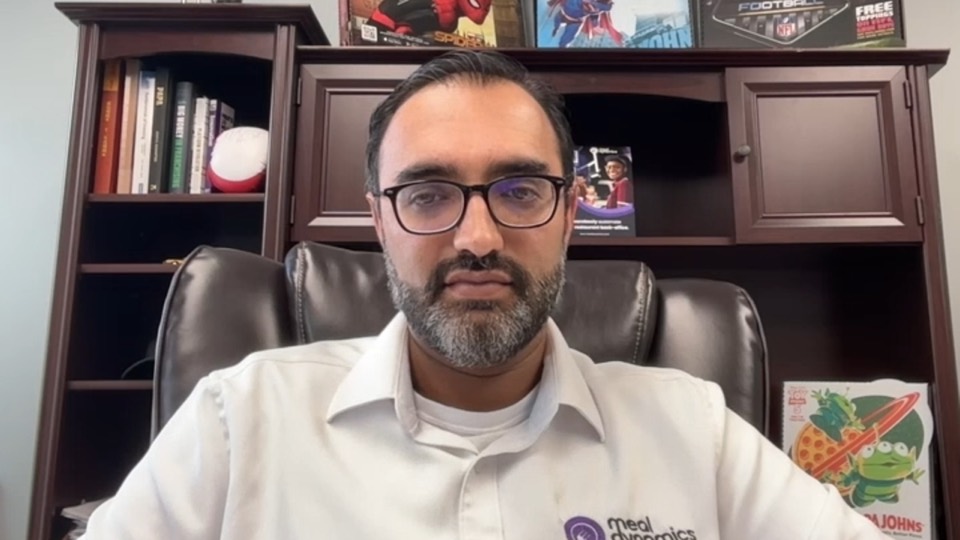
Eusha Bajwa, Founder/CEO at Meal Dynamics, is the guest on episode 75 of the Restaurant Tech Trends podcast, hosted by Justin Foster.
 Play episode
What Eusha and Justin discuss
- The one sentence his uncle uses to describe how they run 275 stores. It reframes everything.
- Where franchisees actually have room to move on tech — and it's not where the franchisor is looking
- What happened when he took his "perfect" all-in-one to his own ops teams
- His answer on whether AI is shrinking his dev team. Most people guess wrong.
Also in this episode
- The rapid fire round: the garlic sauce move you'll want to steal, the most OVERRATED restaurant tech, and how he finishes "the back office should feel like ___"
Episode notes from the host
His uncle started as a Papa John's delivery driver, then bought a single store in East Liverpool with a pile of used equipment. That business is now 275 restaurants across 10 states and they're rapidly closing in on 500.
Today on Restaurant Tech Trends I sit down with Eusha Bajwa, who leads technology for the Bajco Group and is Founder & CEO of Meal Dynamics. Eusha got tired of watching the back office run on spreadsheets and email, built the fix in-house, and turned it into a product he now sells to other operators. First-time founder, and his own toughest customer.
Transcript
Full transcript (6,944 words)
Machine-generated transcript; names may be misspelled.
0:00 Hey everyone, welcome to Restaurant Tech Trends where we explore restaurant technology trends with some of the industry's biggest movers and shakers in a rapid fire short interview format. This podcast is brought to you by Incept AI. Incept AI takes restaurant orders over the phone and in noisy drive-thrus with friendliness and precision. Learn more at Incept AI. I'm super excited about my guest today. We've been trying to get this together for a while. He grew up in South Africa. Inside one of the biggest Papa John's operations in the country and then built software for it. Eusha Bajwa leads technology for the Bajko Group, the Ohio based franchisee. His uncle Nadeem started as a delivery driver before buying a single store in East Liverpool with a pile of used equipment. Today, Bajko runs more than 270 Papa John's, I think 275 across 10 states with a stated ambition of opening 500, which is absolutely crazy. Along the way, you should have got tired of the back office being held together by spreadsheets and email. So he built the fix in house AP automation, R&M tracking expenses, vendors, checklists, and then he did what any good entrepreneur would do. He turned it into a product, which is meal dynamics, a product he now sells to other operators. He's a first time founder, his own customer, and he also runs a dev team out of Pakistan, right in the middle of this huge AI shift we're all going through. Eusha Bajwa. Welcome to the show.
1:34 Thanks for having me. Absolutely. Like I said, we've been trying to get it together for a while. I think we've had a couple reschedules. We met, I think, last year at Murtek for the first time. So I'm glad we're finally able to kind of close this connection and get this podcast up here. I'd like to talk before we get into meal dynamics. Let's go into your background just a little bit. So you grew up around a business that started with the single store in East Liverpool, as I mentioned in the intro. What is the version of that story that I just described that you actually lived versus the version that shows up in the press? Or was it basically exactly the same? It's the same story that my uncles are self-made people that put this business together. And what you see in the press is what it really is. It's the, my family set the bar really high by working really hard to put this whole thing together. And along with restaurants, now it's a lot of other aligned businesses in service industry, serving, again, our restaurants and other people's restaurants. So it's the story of discipline. It's the story of serving the customer. It's the story of people management. And then the philosophy at Bajko is the people, it's a people's business that we are in. And it's not food business.
3:05 Yeah, I totally agree with that statement. We are 100% in the people business about people making food, serving food to people interacting with people. I'd like to double click a little bit into Bajko, because you basically kind of grew up in this like family dynasty, right? And you're second generation. So tell us like, what is the standard that you're measured against? And when you bring an idea to the table, what is the bar that happens? What is the bar that has to clear? And then valuing the relationships the same way that our previous generation did. It's not that easy to do, because everybody brings different things to the table. So that's basically just living up to the, you know, it's big shoes to fill, basically, being taken into the position of such a successful leadership that we have here at Bajko.
4:30 So it's just a lot of discipline, a lot of understanding. This industry has been changing a lot too, since we started to where we are now. The margins are really, really thin. Yep.
4:43 It's just getting harder and harder to survive, especially in the quick serve restaurant industry. Yeah, I do want to dive down into that a little bit later on in our interview. But before, tell us, because I think from your time at Bajko, you know, we talked about 200, 275 restaurants, you're looking at the P&L across all of them. What did that teach you that you're now bringing to, say, Meal Dynamics? And then also, what perspective did that give you that you wouldn't get if you were just, say, in one store? Sure. So here at Bajko, there's a philosophy that we live by, and it's my uncle's philosophy, which is we don't run 275 stores. We run one store 275 times. And what that means is that we have the same processes. And these processes have been designed year after year over decades that we have now put into practice. Now, being a senior financial analyst at Bajko, what it taught me is we were looking at so many different fixes and so many different problems across different stores. So we've tried a lot of different things to fix in terms of bottom line, in terms of top line and middle of the P&L.
6:01 So just looking at and having access to all of that, having access to the problems, the way we've tried to fix them, some things work, some things didn't work. So that really gave me a lot of insight and gave me the drive to do what I'm actually doing right now. I love this philosophy of we don't run 275 stores. We run one store 275 times. That's got to be, you know, let's talk about that for a second, too, because you guys are a franchisee, right? So it's typically like the franchisor that's setting the brand standards and setting the op standards. You guys are so large. What did you do? Like, can you just give us an example or two, like something that you were able to implement on either the brand side or the op side that really helped you do that, helped you run each store like it was the same? So there's, you know, let's just talk about technology. There's two parts to technology. One is the mandatory tech that a franchisor mandates their franchisees to use. OK, so that's it's pretty much the same in every concept. So put that aside. And then there's not there's a lot of things that franchisors don't touch. That's the non-mandatory tech. Right. And there's a lot of things that can be improved or, you know, franchisees can actually experiment in that domain. And with the scale that we have, that's basically what what I'm doing at Meal Dynamics is we are touching all the non-mandatory points, touch points that we could touch stuff that that franchisors don't really care how you manage it.
7:38 As long as you're running the business, as long as you're serving the customers up to their standards, as long as you're managing your people the way you should be managing them, those points really don't matter. That's where we came in. And that's that's with the with the margins in today's day and age. The margins are so thinly squeezed. That's where all of these non-mandatory technology solutions come into place. OK, well, that was kind of previewing, I guess, our next question, because I wanted to get into a little bit of the origin story. But that that is pretty much it. Right. You looked at like all the non-mandatory tech say, hey, we're going to bundle this into platform and the motivation is really margin preservation. That is the overriding goal behind this. Or what is it? Yes, it is. It is. You know, so that you you you hit the nail on the head with that. So it is basically bottom line, but a preservation. But you don't you don't get to bottom line without having satisfied number one customers. And you don't you don't get to satisfy customers without having happy people that are working for you. So you need to have a team that's really, really especially for restaurant owners. It's there. The biggest thing is, hey, you've got to get your team satisfied and then they're going to be able to serve customers the way they should be serving the customers.
8:54 Right. And having a happy team means now with all these different solutions out there, with all so many different logins going around, you can't. Tech adoption is really, really a big challenge in the in the restaurant technology space. And and there's people are not willing to try new and now it's it's like it's it's fatigue that's hitting the industry. Right. With so many logins and you've got to go go here for that. You've got to go here for something else. And for sales marketing, it's different for for accounting, it's different. And then for accounts payable and then operations management. So that's where we were able to bring it all together in one place. I love it. I mean, I 100 percent. I do agree with you. So many point solutions, so many logins. At the end of the day, you have to not only be saving money or making money, but you also have to be making the team's life easier. And certainly that is one of the biggest arguments in favor of platform consolidation. The other flip side that we like to talk about sometimes is the best of breed and how well you're able to kind of capture best of breed sticking inside of one tool. So help us understand that. Now you've got meal dynamics. Okay. You're not this is no longer just something that you're running with one brand or you're working with like multiple different franchisees, different brands.
10:19 How do you make that case to say, hey, it's we are, in fact, like providing the best solution, not just the easiest solution? That's for the being the best solution is for our customers to decide. Again, the standard that we go by is the customers. So a happy customer means, one, the solution that we are providing is less of a hassle for them and more of an asset for them. And two, it's actually bringing them savings. It's creating bottom line savings. And that's how we started, like the idea of how why we wanted to put meal dynamics together. And and it's taken it's taken a long time for us to even convince our own team. So basically how the bar that was set for me is a when will I be able to pitch it to external clients as once our internal teams are happy. And my uncle having highest standards, really high standards, it was very hard to to convince him because basically I had to convince his team. That means all the different operations operations teams out there. Everybody had different needs, had different expectations from us. So we when when we went into a deployment last year in March, we thought we had created the best solution out there.
11:38 We were hitting all the pain points. It's it's one in all in one. We have all these back office solutions out there that are now out there individually targeting repair maintenance facilities. Management is separate accounts payable. There are separate solutions for that operations management. There are separate separate solutions for that. So we thought, hey, we are just providing one login and all of that in one place. Why wouldn't people be happy? But trust me, when we went into the market, they everybody had their own inputs about each and every separate solutions there. And it took a lot of going back to market and then coming back to the drawing board. Hey, fix this or fix that. And a lot of feedback, a lot of back and forth. But eventually we were able to get it to a point where now the operations team thought, hey, you know, we we we are getting the benefit. Hey, we were looking at time savings. That meant efficiency. We were looking at bottom line savings because we're providing insights. We're providing data, timely data that that when it matters. Right. So because in the restaurant industry, you know, it's today's gone. The sales gone, whatever you did, whether you comped or whether you didn't comp, it's all it's gone. It's in the past. You've got to focus about tomorrow. So those timely matters. Hey, if you did bad, what happened? Why did these leakages occur or if any leakage even occurred or not?
12:57 That data really matters because then you can improve upon it tomorrow. And every day counts. Every day. All right. Well, I want to dive into, you know, how long it actually took you to do that. So you finally got the green light, your uncle, all the ops teams like, great, let's go ahead and do it. You put it out there. A bunch of stuff breaks. You get all the feedback. How long did it take for you to get from there to having a good, stable product with good product market fit? And then this is kind of a two part question. So that's kind of the easy part of it. The second part of it is we are living in an age of AI right now. And, you know, everyone is using cloud code. Like it's dramatically accelerated time to market for building software. How are you using AI to speed your time to market and speed, you know, fixes of different things versus running this offshore team in Pakistan? Are you trimming the size of the team? Is everyone on the team using the tools? Like give us the insight into what's happening there. So, so, okay. Now the first part is it took a long time, longer than we had initially thought. Okay. So a lot longer than we had initially thought.
14:13 And that's how it is with, with all, all operations related and practically related solutions. You bring a solution to market and you hope that it would work the way you think it would work. But it's like the first time it usually doesn't work that way. And you've got to go back to drawing board. You've got to fix some of the things. And fixing it and fighting the product market fit is way harder than actually initially developing, putting the requirements. So one thing we had in our benefit was the requirements we were gathering in-house and, and before we went out and met some other restaurant owners from other concepts, we had our internal brainstorming. And that we, we spent a lot of time on actually gathering the requirements, putting that into perspective. And that's when AI was not big yet. But now with, with AI coming in, that became even easier. You're putting requirements together and, and making sense of it for the devs to now take on. It really provided a lot of help. Now to your second part of the question.
15:16 We, we think, and in our company, we have the philosophy, AI is definitely not replacing, at least for me right now in my development team, it's AI is not replacing. Devs. Okay. It's enhancing. It's making it more efficient and it's enabling them to have at least three X output or even more than what they used to have. So we are running two week sprints and what we were able to accomplish in one sprint is now way more than what we are going to. So now we are basically running three sprints in one just with the help of AI. So yes, we, we, I mean, we have, we, we have no plans of changing the way we are running our dev team because with AI now the quality of development has gone up a lot. Yes. There's a lot of questions out there with offshore, offshore dev teams. And, but we have seen is AI has leveled that playing field and has actually, without increasing too much spend, has increased the quality of our, of our output, the efficiency of our output. And, and, and it's, it's working really well for us. And it's actually has, has added a lot of quality to, to our output. And we are also the, the, the, we are able to now divide our team into two separate efforts. Say one is, you know, working on, on fixing what we currently have.
16:34 When another team is actually working on bringing new features into, into our platform. And at a way faster speed than it would have been if, if there was no AI. All right. I'm going to try to pin you down a little bit, but feel free to evade if you like. And it's kind of a bad question anyway, because being in software industry, like, you know, like nothing is ever truly fixed. It's always like a never ending cascade of problems that you're working to solve. But can you give us a range? Can you say like, was it six months from the time you first put out until you feel like is stable? Nine months, one year.
17:07 That's a good question. So we, I mean, having, having seen the level of the quality, the way I would like to be, I would think that we're still improving. So we're still, we, we, we're still not there. Yeah. And, and, and I wouldn't, I wouldn't ever want to be comfortable. I wouldn't want any of my team members to be comfortable with what we have right now. So yes, there was, I would say, say it was between six to nine months where we got the operations team to be happy with our product. But because of there's so much out there that still needs to be done. And there's so much efficiency to be achieved. And there's so much leakages to be stopped. We still think that we have more work to do. So our customers, even though they're happy, we are still striving to provide more efficiency and to provide a better solution. All right. Okay. Valid, valid answer. I want to go back to something earlier. You said you talked about the advantage of being able to be your own customer and having all these internal groups to like give you feedback. I would 100% agree. This is a massive advantage that you have in coming to market. Interesting, by the way, I don't know if you know this, but seven shifts started out the same way, you know, building like solving problems like inside the restaurant and then going out and productizing.
18:25 But also, it can potentially not always be an advantage because like Bosco, I'm sure, does certain things like the Bosco way, right? And that's just the way that it's always been. And it works really well. Then you go outside, you start talking to another brand, and it turns out it doesn't really work that way for them at all. Can you give us an example of some of that internal thinking? And was there a time when it actually set you back and you said like, oh, we actually have to like design something else or we need to make this thing more flexible or generic?
19:00 Yeah, that did happen. And that happens almost every single time we go to them. And this is how it is, especially with restaurant operators, but with anybody out there in the field. But restaurant operators don't like to change the way they do things. They do not. No, they don't. And their employees don't like to use to change the way. For example, when they were doing a paper checklist for cleaning and for daily opening, daily closing checklist, moving from paper to software, it's way more efficient. But changing the way people do things is the hardest thing. It's the hardest thing to get them to agree to do that, right? So, yes, we did face this a lot of times. But, you know, being a startup founder, we have a pilot customer and we got to make them happy in order to be successful, especially when bar for me was, hey, you got to get the employees at Botchco to be happy with the product before we can go and we can start selling it outside Botchco. So, having that, we went twofold. We said, okay, fine, we're going to give you what you want. But every single time our team wanted something, we built enough flexibility into the software where we could do things differently. And we built enough scalability there that we are able to deploy different models of management, different models of upkeeping, different ways.
20:21 So, yes, we did face a couple of times we had to do things the way Botchco wanted us to do it and then build different ways of doing things into it down the road. All right.
20:36 And it was a big, I mean, 275 stores is a, it's a big customer. You can't ignore them. Even if they're not your first customer, you can't ignore them, right?
20:46 A greater truth has never been spoken, my friend, for sure. So, I'd like to talk a little bit about the surface area of your product. When I hear about some of the problems that you guys are solving, like AP automation, R&M tracking, expenses, vendors, checklists, I think of guys like Restaurant 365. It's kind of like the 600-pound gorilla in the space. Would you consider them to be a big competitor for you? And then sort of secondarily, like you are covering a very wide surface area for a young startup. And that is, has challenged a lot of startups, right? There are a lot of people out there that will say like, hey, you just talk, you do one thing, you do that one thing really well, and then you start adding the rest. But with what you're doing, that's really not part of the pitch. So, yeah. You know. That's a good question, yes. And I get this asked many times. Now, here's the thing. We, first of all, we didn't build it with the expectation that, oh, we're going to be selling it outside. We, the first thing we did is we try to solve our own problem. We saved, we faced these problems. And it started with one problem. And then when, because now, now see the thing is Bajko has different teams. Bajko has its in-house accounting.
22:02 Bajko has its in-house construction team. Okay. And, and that also manages facilities management. Okay. For the repair and maintenance of, of, of systems. So, we, when we build it, started building software and all these other teams in Bajko heard of, hey, you know, we have our internal tech team now that's putting software out there. So, they started coming up to us with their requests. So, we actually, we, we, we solved our own problems. And when we, when we saw that it worked for us is when we decided to, hey, we're going to now go outside and, and other people want, want the same thing. Now, what's different for us than all these other tech solutions and especially the one, first of all, I don't, I, I hate to say that, hey, you know, we're competing with this or we're competing with that. We are a restaurant company. So, we, we are operators. And it's not often you see operators building solutions too, right? So, so we, technology folks have their own way of solving problems. But when an operator actually comes up with a solution that works for them, they, what's, what's in their mind? What's the first and foremost thing? Hey, it has to be efficient. It has to be cheap. I know the pain. And I know exactly how, I don't know if this is the right word or not, but how frugal my uncles can get when it comes to paying for technology solutions that are not proven yet.
23:23 Right? So that, that is it. And that's how all operators think. So, when we were building all these solutions, that was in our first, in our mind was, hey, we got to stay cheap. We got to stay within, I mean, within the comfortable, comfort level of operators to be able to pay for them. So, yes, it is, it is a broad product. But we, all these problems we faced inside Bajko and we solved it for within, within, within Bajko's teams first. And those teams approved the product that it actually did provide help in their function. So, the accounts payable help our accounting team in, in communicating. As, as you mentioned, beginning of this podcast, it was all emails and all spreadsheets that used to go around. So, we eliminated that and now everything is within, I mean, it's on a platform. It's, everybody has visibility to it. Anything going out of a certain range that it should be, it gets, everybody gets prompted on it. That same platform is tracking our assets, tracking our repair and maintenance flow. And that used to be emails. Imagine on a Friday evening, your oven going out and you're playing a round of golf and you don't see your phone until two or three hours later.
24:42 When all the vendors are gone. So, we have, we've built systems and those systems can be tracked within our solution where everybody gets, if, if one person is not able to respond. There are other people in our, in our management, in our, in our hierarchy that are able to respond to, to events. So, nothing gets, nothing falls through the cracks. All right. Let's take a step back and talk about how AI is shaping technology in general and technology solutions providers. You know, you show, cause we've done, we did these dinners before these future of restaurant tech dinners. Um, you know, we did one a couple of weeks ago and we asked everyone, Hey, how much time are you spending in your day using cloud? Like, what are you using cloud to build and to automate? And I think for my, my top, my initial visceral reaction to sort of what's going on in the industry right now is there are a lot of vendors that, uh, I do believe are at risk of, uh, basically just becoming irrelevant. Because AI has made it so easy to build these sort of small point solutions, you know, things that are not solving a bunch of problems. And there are, there are a lot of people out there that would argue AI also would enable you to build, you know, much larger systems like POS and do that in a very reliable way.
26:05 Do you see this as an opportunity for you guys, or is this more of a threat for you guys? Do you see more of your customers becoming competitors because AI is now making it so easy to like solve some of these problems? Or do you think, I'm not trying to like tee it up completely for you. Do you think this leads to like reliability, scalability, maintainability, like issues in the long run? How do you see that playing out for you guys? You answered your question. So basically see the thing is, um, agent, like, like I, I've been, I've been seeing how in the restaurant industry people are using AI. A lot of it is to, on the top line end, like a lot of, a lot of people are using AI, um, and using, and they have a lot of data, customer data, and they're using AI to figure that out. Uh, what meal dynamics does is back of the house stuff, right? So that's number one. Number two, um, people will always come up with creative ways of using AI to solve their problems. But, you know, restaurant operators, what's their first job and what's their first priority is to sell food and to serve their customers. Now, if they're to focus on that, building any kind of an agent or building any systems that provides, that does 80% of what you want it to do is easy. But getting to 95%, 99%, or even 100%, which nothing is ever 100%, but getting close to it, it takes a lot of time, a lot of refinement, and a lot of repetitive stuff.
27:33 So, so this is actually an opportunity for technology providers. AI is an opportunity to get from 80% to 95%, 98%, 99%. And that's, and that's where, so there's, I don't think it's a threat. I think it's an opportunity for everybody. If you're, if you have a couple of restaurants and you're able to build a system that provides you that level of efficiency, that's amazing for you. But it's, it's, then you're not, you're probably not spending time on serving your customers and providing food. So that's where technology providers like us come into play. You know what, Eusha? I absolutely love that answer. And I also suspect there may have been one or more investor meetings where you had a similar answer to the question like that.
28:18 But yeah, everybody wonders, like, hey, it's so easy to do it. I mean, it's easy conceptually, but nailing it and narrowing it down to actually solve the problem is not easy at all. And I agree. I agree, man. And I mean, it's one of those things. I mean, we see it here with what we do at Incept AI. It's like, there are so many like small little edge cases and so many weird little things that you have to solve for that are just really difficult to do unless you're focused on it and have a maintained focus on it. So I, I, I love your answer. Okay. We talk generally about, you know, some wins and losses, you know, founders love to talk about the wins, of course. But why don't you give us an example of something that, you know, something bad that's happened since you, since you started out? What was it like something product related teams? What was something that didn't work? And what'd you do to repair it and move on? I'll tell you, I mean, being from the family, we, I, I did not get any favorable experience when it came to Bajko's operations. Okay. So we, the bar I had to clear for this in order to call my solution a success was, hey, are the operators happy with it?
29:39 And, and, and that was the hardest thing to do. So when we went to market, we thought, hey, I've been doing this since 2012. Okay. I know exactly what the problem is. I know what the problem they face every day. And I thought the solution I'm going to come up with is going to be the solution that's going to work. But when you go to field, you hear all these different people, they have different ideas. It was the hardest thing to do was getting them number one, to adapt, to change and adapt to getting from moving from paper pencil or moving from like semi-digital solutions to something that was automated, like meal dynamics. That was really, really hard to do. And getting them to, to say, hey, this, yeah, this solution does what it's supposed to do for us. That was the hardest thing to do. And, and, and the first time when I went in and I got shot down was a big bummer because I thought I, I've been doing this since I was in, I was in undergrad. Right. But how could I, how could I, I mean, how could I not come up with a solution? Yeah. All right. Well, it's just the world we live in right now. Every vendor in the ecosystem says that they are AI powered. So when you look specifically at the back office, back office functions for restaurants, where do you think AI is like there, like we have it, like it's working completely.
31:00 And then what in your view is still more of like, it's a demo. We're not quite there yet. There's a lot more that needs to go into it.
31:08 That's a great question. So it's a work in progress. Everybody's still trying to figure out and AI has great potential. It has, it is able to do so many things and everybody's still trying to get that sweet spot where it does everything you want it to do. And it provides greatest efficiency for us. A lot of, you know, the, the cracks, where do they, if on a weekend, if, if your food license, you forgot to renew your food license and the food inspector, especially in one of, one of those small towns, they have, I mean, I don't know if I should say this or not, but they have nothing better to do. And they stop by on a Friday evening and they're like, Hey, your license is not renewed. You're shut down. That weekend is going to cost you 1% of top line, roughly.
31:51 You're not able to get that restaurant back up and running by Monday. So that just missing that one renewal is going to cost you dearly. Your budgets are off your top line, your bottom line, everything's off. Okay. So we, what we're doing is we're trying to figure out those. And, and obviously using air, we're trying to figure out those, those things that, you know, human beings in their, in their busy routines, they, they skip, they miss. And we are able to catch it or our system is able to catch it. So it takes a little bit of working. It takes a little bit of training. It takes a little bit of data gathering in order to get those suites for, Hey, you know, this is where we can, we can have, we can send reminders or we can have, we can see where, what is missing and bring it online. All right, cool. Well, I love, by the way, the fact that you are a franchisee and you're building technology because you really understand like the margin pressures in a way that no matter what a franchisor says, they just do not understand it in the same way as a franchisee. And franchisees famously are very skeptical buyers. You mentioned earlier, you know, the hardest thing was you take the tech, you take to an operator and you have to clear that bar where they just say, okay, it works.
33:09 Like this solves the problem that I'm having. Is that the thing that is like the secret unlock to like getting franchisees to buy? Is it that and cost? Is it that cost and something else? What's been the biggest one in your experience? I think it's a, it's a, it's a little bit of all of that. So all of the above. Why? Because cost is always the biggest thing, especially in today's, the margins are so thin. Nobody wants to spend money on something that is not yet been proven. So peer, peer reviews and, and, and references go a long way. And cost is always the biggest thing. So, I mean, it's all of that combined. I mean, some people might put more weightage on cost than they might put on, on, um, something that's worked before on our peer review. Some people might put more weightage on the other, but it's a combination of all. Okay. Fair. Good answer. All right. Well, we're almost out of time. So I'm going to do just one more quick question here. Um, give us your, you know, one sentence pitch. Like what makes you guys different? Why would someone go with meal dynamics? And then tell us where can people find you and learn more about the product?
34:26 All right. So we, we are software. It's built by operators for operators. That's our pitch. And, and, and I don't think there's a software out there that, that does that. We built it for ourselves because we felt the pain points and we understand your pain. And now we're providing it to you also. So, so that's our, uh, that's our, uh, uh, our, our biggest pitches. Um, and, uh, uh, you can find us on www.mealdynamics.com, um, and reach out to us. We'd love to show you what we're doing. Um, and we'd love to have you be a part of our journey. All right. Well, you should.
35:06 I'm super excited that you were able to come here on the podcast today. We're not done though, because now it's time to go into our rapid fire section. So for everyone watching or listening about to ask Eusha a series of questions, he has no idea what these questions are because he has not seen them in advance. The rules of engagement on these rapid fires, Eusha are try to answer each one of these questions with one word, if you can. And if you can't try to answer with one sentence. Are you ready? Yep.
35:37 All right. Your favorite Papa John's order. No diplomatic answers. What's on it? It's a, it's a veggie thin crust pizza. Veggie thin crust pizza. Okay. Let's talk a little bit about garlic sauce. Okay.
35:53 One garlic sauce per pie or one garlic sauce per slice. So that's it. That's a good question. I just have them spread my garlic sauce on the, on the, on all of pizza before I eat it.
36:10 Dude. Garlic sauce is like my kryptonite, man. I love that stuff. It is so addictive and so delicious. Okay. Pineapple on pizza. A lot of times. And this might, next time you order, you might want to try it. I have them not put pizza sauce on and just put garlic sauce on as a white sauce and have the pizza that way. Okay. I'll try that next time. I, my next Papa John's order.
36:33 Okay. Pineapple on pizza. Hill worth dying on or let it go. Let it go. I know that's good. Especially even in our, even in our house. I'm like, I sit down with my uncle sometimes and I'm like, but why, why, why do you, why did they even think of this? But you know, it is, it's, it's the way it is. And, and there are a lot of people at Papa John's that love, love having pineapple on there. You know what, brother? We are like on the same page. I, I do not get it. I pineapple. It does not belong on pizza. I'm sorry. Go, go eat it in a fruit salad or something. If you really want it. There you go. Yeah. I love pineapple. I mean, I have it in breakfast, but that's where it belongs. Not on my pizza. You draw the line, draw the line to breakfast. I like it. Okay. What is the spreadsheet that you're most embarrassed still exists somewhere in the business?
37:34 It's, I would say it's the checklist and I just don't understand why, um, your operating checklist has to be on a piece of paper in today's day and age. Microsoft Excel has been, I mean, for a very long time, but it's, it does not with today's technology. You do not need to track your daily operations on a piece of paper or even in a spreadsheet. It does not belong. All right. What is the most overrated piece of restaurant tech today?
38:10 Overrated is, um, uh, I think it would be, uh, some of those top line solutions because you know, your customer the best, um, you should not need, um, some of those, uh, analytical solutions to provide you with, I mean, to provide you with insights to understand your customer. Okay. Um, working for the family business, is it harder or easier than people think? It depends if you want to just survive and if you want to just take the paycheck, it's way easier. But if you actually want to, uh, uh, grow it, or if you want to bring a change to it, not even a change, but if you want to put, if you want to enhance it, then it's not easy because, uh, it's always bigger shoes to sell, to fill because founders always have a certain kind of, it's their baby. The business is their baby and putting input, bringing value to that is not always easy because it's always a big shoes to fill and high bar to, to satisfy. Yeah, that makes sense. All right. Last one, Eusha. Finish the sentence.
39:25 The back office of a restaurant should feel like blank.
39:32 It should feel like a breeze.
39:37 I like that. You could build a whole brand around that. I feel like. All right.
39:43 Well, Eusha, I really want to thank you for your time here today. I learned a lot. This was a super fun conversation. Everybody, Eusha Bajwa leads technology for the Bajko group. He's also founder and CEO of Meal Dynamics. Thank you, Eusha. Thanks for having me. Thank you so much.