Episode 69 · July 22, 2026
Andrew Kirkwood
VP Technology · Shelby's Legendary Shawarma
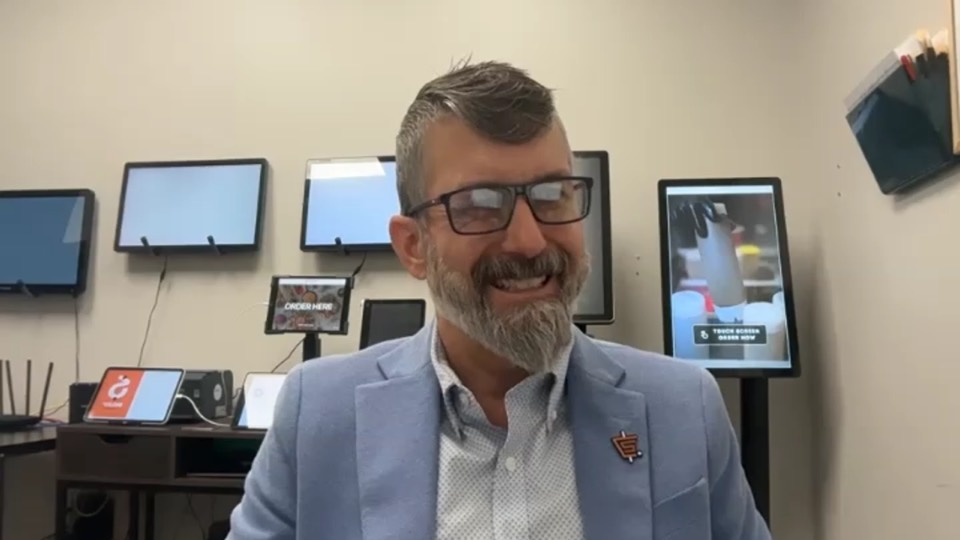
Andrew Kirkwood, VP Technology at Shelby's Legendary Shawarma, is the guest on episode 69 of the Restaurant Tech Trends podcast, hosted by Justin Foster.
 Play episode
What Andrew and Justin discuss
- How a viral social media character - and a very illegal bottle of ketchup - built a global fanbase before the brand had 5 stores figured out
- What it really takes to standardize a menu that never stops changing when your CEO loves to experiment
- The shift from best-in-breed vs all-in-one, and why AI is finally tipping that debate -->SUPER hot industry topic right now.
- Why he wants POS to stop being the foundation and start being the data hub
- The AI vision that turns demand forecasting into real-time, dollars-and-cents actions a franchisee can actually see
Also in this episode
- The rapid fire round, where Andrew names the most overrated tech trend in restaurants
Episode notes from the host
"You can't put ketchup on shawarma" became a global rallying cry, and the brand behind it is now blitzing past 50 locations...
Today on Restaurant Tech Trends I sit down with Andrew Kirkwood, VP of Technology at Shelby's Canada, the brand turning authentic Middle Eastern flavors into North America's next big fast casual category. Andrew came up on ops, ran business development, and now owns a tech stack he is rebuilding for scale.
This one is packed with the real, in-the-weeds truth about scaling a brand people fall in love with online before they ever walk through the door. Give it a watch and let me know what you think
Shout outs to Bikky, Gravy.ai, Toast, and MYR for the vendor love along the way.
Transcript
Full transcript (7,181 words)
Machine-generated transcript; names may be misspelled.
0:00 Hey, everyone. Welcome to Restaurant Tech Trends, where we explore restaurant technology trends with some of the industry's biggest movers and shakers in a rapid-fire short interview format. This podcast is brought to you by Incept AI. Incept AI takes restaurant orders over the phone and in noisy drive-throughs with friendliness and precision. Learn more at Incept.ai. Today, I am joined by Andrew Kirkwood, VP of Information Technology and the Director of Incept.ai. Incept AI. We're going to be working with the first-time technology at Shelby's Legendary Shawarma, the London, Ontario-based fast casual brand that's grown to 49 locations. We got two more. I just learned they're going to be opening in the next week, so they'll be past 50. Be up to 60 by the end of this year. It's pretty crazy. They're bringing bold shawarma to communities across Canada and now the US, their first US location. Andrew brings over 30 years of experience in the space spanning fine dining and QSR. And before moving into tech, we're going to be able to get a little bit more. And when we're back, he ran business development for the brand, which is very cool. Today, he's focused on helping franchisees run more efficient, future-focused stores in a fast-growing Middle Eastern QSR space. Andrew, welcome to the show. Thank you very much, Justin. Thanks for having me.
1:15 I'm excited that we got to have you on here. I'm excited to learn all about Shawarma. It is a crazy fast-growing spot. You guys occupy a really cool niche that I think a lot of people are still learning about right now, quite frankly. And just because I think a lot of people that are watching or listening may have not heard about Shelby's, can you give us the quick rundown? Tell us a bit about the brand. You guys have a huge social media following, which is pretty unusual. And maybe just give us an insight. What's something about the Shelby story that people don't always see from the outside? Yeah. So Shelby's legendary Shawarma was the brainchild of our CEO, Yazan El-Shilabi. And it's a play on his last name is where the Shelby's comes from. And we've been around since 2015, started franchising just at the end of COVID. And I came on board sort of in the middle of that first franchise location, close to the end of that first franchise location. And Shelby's is all about is trying to do authentic Shawarma Middle Eastern flavors, but make it more accessible to the North American public. Broaden that dynamic a little bit by fusionizing some of the flavors and some of the concepts of the dish.
2:37 Shawarma, the word itself means like to turn. And so I think a lot of people are familiar with pita type sandwiches in kebabs or in just regular pita restaurants. So really the Shawarma piece is just about how we cook our chicken or our beef lamb mixture. And that's on a spin that rotates. And that's why it's called Shawarma. What happened with Shelby's was we got really strong influence on social media by creating characters that sort of made fun of the Middle Eastern restaurant experience where, you know, we like to play on the idea that you go into the restaurant and there's this guy that seems angry and he's yelling and yelling at his staff, but really just has a big heart and really just wants to show the world his food and what he can do. And it really resonated. And we got huge following on social media, the characters that we created, Shawarma man and a guy named Billy, who comes into the stores and tries to put ketchup on shawarma, which is like a no, no, you can't do that with shawarma restaurants. And so we tagged the line, you can't put ketchup on shawarma. And like shawarma brands all over the world have now adopted this phrase and are living by this, this sort of credo. And the smart thing of our team, Yasser and Sultan, who came up with these characters was they stuck to it. They didn't try and change this idea of now we got popular on social media, let's do something different. They really stuck to these characters.
4:12 And I think that's what really resonates with our fans for sure. One of the funny things is we have a merch site and I see people buying Shelby's merch from all over the world, places that have never been to Shelby's and they're buying our merch because of the characters that we've created online. That's cool. Yeah. I want to dive a little bit deeper into this because you're right. Shawarma has really existed as a category that's really been dominated by independence for a really long time. It's really big in Canada. Also, even in the US, it's pretty much all independence even today. Was it really the social media thing that kind of kicked off this brand? What does it take to actually modernize this type of a concept and get it ready for franchising without losing what people like about shawarma in the first place or in the case of Shelby's what made the restaurant number one work? Yeah. I think there is a, in the restaurant industry, there's cycles and nobody wants to open a burger joint. Smash burgers forward for a little while and nobody wants to order it, open a chicken joint anymore or chicken sandwiches or burrito. The new thing is bowls with the Cavo or the Chipotle experience. And I think shawarma is a sexy new sort of category that the restaurant world is getting into. And mom and pop shops have done it really well for so long because it takes a lot of care in doing this product well.
5:41 And it's tough to do it. And it's tough to do it at scale, especially without really good systems and standards in place. And, you know, when people have shawarma, I think it's almost a no brainer to be like, why isn't there somebody doing this? And our CEO is a genius when it comes to branding and innovation and one of those guys that will try sort of anything and see if it works. And he had a lot of people telling him he needs to start franchising this business. After that first location opened, it was so busy. And it took him a little while to be like, do I really want to go that path? And then he met somebody that could help him franchise. And they threw their hat in the ring and they, without having a bunch of knowledge of how to make this happen, they tried. And halfway through that experience, I got the phone call and they said, hey, we're trying to take this thing and franchise it. And it's, we're not ready. We don't really have the foundation to make this happen and we need help. And that's when I came on board after rolling through that first location is to be, you know, the person that's going to standardize, make some SOPs, understand a little more about governmental compliance, franchisee onboarding, some training, how the systems are going to play together, and then how we're going to take this thing to scale.
7:02 The thing is, it even is more difficult when you don't have the foundation of your menu set. The creativity of our CEO means that he's always evolving. He always likes to try the next thing. And so you're creating systems around this thing that's always in flux. And so there is definitely been some growing pains along the way. And we went probably five or six franchise locations before we started building a team around us. And so it was really just five guys in a room trying to figure everything out until we started to say, okay, this is bigger than the five of us. We need help here. And since then, we've started to build some foundational support mechanisms that help us. I love this story. I just had someone on the pod last week from a brand called Vicious Biscuit. They're a little bit younger than you are more of the tweener stage, you're kind of exiting that tweener stage, spreading your wings. But this is just like the really unsexy stuff that you have to deal with in order to get that brand ready. And I would love just especially since you've got the ops background, like you mentioned menu is a challenge, right? And you're always making menu changes.
8:17 And you've got to set the brand standards, got to set up standards. What were maybe like just share like one or two of the toughest things that you had to deal with is you put those standards in place working with franchisees? Where were you getting a lot of pushback? Yeah.
9:32 I feel like we've evolved to the point where we're understanding that getting the non-tech things buttoned up really helps the tech side thrive. And we're starting to get there a little bit now that we've grown out our team. And so I think some of the early inefficiencies were around community driving, local restaurant marketing, really having a franchisee onboarding plan that started at a beginning process and got to an end process instead of lumping things all together. And so I feel it's taken some time. It was probably 10, 10, 12 stores before we got a process involved where we had an actual onboarding schedule where we were like, okay, we need like two or three weeks of just back office understanding and training for the franchisee. Then we get on site. Then we do some on site training. Then we bring their staff in. And so that process took a little bit of time to evolve and definitely some pains along the way. How understanding were your, I'm assuming these are early franchisees with going through these growing pains. Was this a top down kind of process?
10:47 Was this a bottom up? I'm hearing in what you're saying, there's probably some friction that happened here as well. But did you have, how understanding were your franchisees in that early stage? That's really my question. Yeah, I think because not a lot of them had restaurant experience, they were willing to just go along for the ride. They really believed in the brand. They really believed in what we were doing and they could see the future. The other thing is when you have people that are passionate about your business, my CEO is about as passionate about this business as you can be. He works 12, 14 hour days every day, all weekends. He never rests. I'm also that kind of person as well as some other people that were on board. And so when the franchisee, the early franchisees see that kind of involvement with the company, I feel they're willing to overlook some of the inefficiencies to understand that there's an end game. And we're working as hard as we can to get there, right? Yeah, that's awesome. Well, it is a partnership at the end of the day. You talked about TechStack. I want to talk a little bit more about TechStack in a minute. But first, help us understand you a little bit more. So you did come up on the op side. You ran business development at Shelby's. Now you're overseeing the TechStack.
12:05 Take us through that path. How did you come from there to like overseeing the tech? Yeah, so early on, I came on board with my operations background, everything from fine dining to fast casual background. Came on understanding that there was a bunch of holes and we needed to plug the holes. There wasn't any specific direction or specific job title. It was everything that we needed to do to make this grow and run efficiently. And so as that progressed, there was help needed. And so as that help was acquired, we could silo that help. And so what we were able to do is say, okay, we need somebody in training. We need somebody in marketing. We need somebody in construction. We need somebody in these different departments. And as we siloed the support, it was easier for us to then say, okay, how do we start siloing the leadership team to grow more efficiently? And in that sort of mix up, in that sort of time where we were making that happen, I decided that I felt like the way to scale most efficiently in today's restaurant world was to make sure that our tech stack could grow with us.
13:22 And so that being a big project, I felt like that should be the direction I helped the company grow. That being said, I still do wear some other hats. I still help with menu. I still help with restaurant setup and franchisee onboarding. There are still a lot of pieces that I try and stay tuned to. But we realized early on that the tech that we had was inefficient for scale. And so we knew this was going to be a big job to try and turn that around and get something that's going to work. All right. Before we get fully into the tech stack, I am curious to hear about your menu involvement because you said your CEO likes to experiment and there are lots of new things. I don't know if you guys are doing a lot of LTOs, but on the vendor side, I am curious to understand what your processes are for making sure that the menu changes and updates are propagated out to all the parties that need to understand those menu changes in order to fulfill whatever function they're helping your business perform. How are you doing that? Just get in the weeds for just a second, weekly, daily basis. What are you doing? Yeah, for sure. There is still an item on the menu that was a creation of mine, but it's evolved along the way in that to bring people in to the restaurant, we really thought that fusionizing our food was the best method.
14:40 And so we did things like shawarma mac and cheese, shawarma tacos, shawarma quesadillas, shawarma biryani. We really tried to bring in different cultural experiences with our food so that the word shawarma or the word tahini or whatever wasn't scary to people. We wanted to bring them in with this experience that they're familiar with. And that was a great run. And so what we've decided in the last little while is to open that up a little more and say, okay, instead of us telling you McDonald's sort of style of what you should eat with shawarma, we're now going more of you tell us what you want to eat with shawarma. And so we then now brought on a sort of a build your own scenario where you can build your own bowl. But we also still have some fusion items where we direct you in a way that we think makes the most sense when it comes to shawarma. So we increase the amount of toppings and sauces that you can get. But really the process for us is trying to figure out the build order and how that works efficiently in the restaurants. We've also had to evolve because of capacity and the amount of ingredients, our line. So we started out with a single line that was subway style. And then we moved into a double line where we had a bowl side and a wrap side.
15:59 And then obviously with that comes different KDS flows. And now we've evolved into another style line that is a front and back style line that takes different order types. And rolling out new menus in these different environments, I think the problem with the reinvention of the menu along the way is more how do we make it work efficiently in these different sort of layouts. That's been the biggest challenge. But the fun with the menu, we love having fun with the menu. We always try and roll out some new. We did LTOs for a long time, but with this latest menu change, it was a significant enough menu change that we've held off LTOs until people get familiar with this build your own menu style. And the feedback's been great. Of course, there's still people that miss the shawarma mac and cheese. But for the most part, they can make any one of our old Fusion items. Can you give us any insight into sales data from the new build your own or franchisee profitability resulting from the new build your own? Yeah, obviously food cost was a huge consideration when we were rolling out the new menu. And so we really needed to make our menu make sense in a food cost scenario. And so that was really one of our main focus.
17:15 But we didn't want to not have that same experience for our guests. And so we had to tighten up the efficiencies on how we do, especially the big ticket type items as far as food cost goes. And profitability as far as the menu items go per item were much better. The marketplace in Canada is not as good as it was 18 months ago. And so we're definitely seeing a dip in sales because of the marketplace that we're in right now. But as far as item efficiencies, we are definitely doing better. Okay, good to hear. Love to check back on that 6-12 months from now. Okay, now this is Restaurant Tech Trends. We got to talk a little bit about tech. Tell us a bit about your tech stack. What are the biggest components of your tech stack today? Maybe tell us what's been the most recent piece of tech that you've added or replaced? And what are your next tech bets? Yeah, so I think it's funny that it's evolved so much in the last four years. I think everybody for the last 10 years has been talking about best in breed versus all-in-one under one umbrella. And I feel like that's changing. Because of the influx of AI, especially backend tools, where you're getting a lot better data aggregation with the AI experience, finding that best in breed makes more sense.
18:34 Because now it's not disjointed data that you might have had in the old environment where you're pulling it from a bunch of different platforms. And we partnered with a sort of an all-in-one system that was good for us for the first 30 stores, but were acquired by a large payment processing company. And since then have not, I won't say names, but haven't been as efficient or responsive to some of the needs of a growing brand. And so making those changes in the next 18 months is our focus. But like I was saying, with the marketplace the way that it is, and our tech stack's big. We've got five, six KDS screens, order-ready TV, POS, customer-facing display, kiosks, sticker printers, menu boards, promo screens, online ordering app, third-party aggregator. We've got a pretty robust stack. And I feel like because of the way that the marketplace is going, everybody wants, especially franchisees, they all want top-line sales. Everybody wants top-line sales. And I understand that. And nobody thinks it's sexy to talk about operational efficiencies. But I feel we have the biggest opportunity right now with the way that AI has entered the marketplace for us to really be efficient in our operations.
19:52 And I feel like there's some tools out there that are doing that really well. CDP platform, obviously, there's a couple of good ones out there that are in the ether people are talking about, I think is a huge move for us. For understanding the complete guest journey. Better CRM platforms that really expand the CRM piece to better incentivize guests along that journey as well. I think loyalty is another area where things are evolving quickly. And when we're talking about top-line sales not being where they used to be, you don't want to become a discount brand. And so that traditional loyalty platform that was all about 20% off or a free item, I think has to shift. And you have to engage the people in a more individualized way. So things like unlocking secret menus, some gamification, early adoption to LTOs. I think these are the ways to get people more involved with your brand without having to necessarily discount through that loyalty program. And so those are the things we're looking at right now to evolve. And we've been looking at a bunch of different platforms to see who's going to fit best with us to make that happen. But we also have different challenges here in Canada when it comes to guest experience.
21:12 Hospitality in Canada, I have seen a downturn in that guest relations piece in restauranting in Canada over the last five or six years. And trying to find ways to give that good hospitality, I think, is also a function of how we can utilize the technology better. One of those ways, and the CEO of Pepper Lunch, I think Troy Hooper said it at the summit, where what they're trying to do is they're bringing a guest experience by having a greeter. And so they're still directing them to the technology. They're still going to that kiosk or digital ordering experience, but they're still giving that hospitality by having that experience with that guest relations person that's coming in and saying, hello, welcome. Have you been here before? Let me show you how to work the kiosk. And I think there has to be a balance between those things. And so one of the ways that we're trying to give that experience from a tech perspective is having a really good kiosk, having a really good digital online ordering experience and some symbiosis between those things. So no matter how you order, you get that similar experience. I also feel the world of what people call upselling.
22:28 Again, I don't love that word. I think it's really just providing information and then allowing the person, the guest to choose. But giving that experience in a more personalized way, instead of just saying, hey, you should order fries with that or, hey, you should make that into a combo. I think giving that experience of understanding that guest and understanding what that guest would enjoy and then trying to tailor some of those offerings to the guest specifically is another sort of path we're going down right now. Really, where I think the big thing that's going to happen in restauranting with AI is that two things are going to happen. First of all, everybody's challenge is let's move them off the third parties, right? And everybody uses things like bag stuffers and whatever they do to try and get them off the third party. But unfortunately, third party usage is a habit. It's a human habit now. People go to DoorDash to find food. They don't go to it to find Shelby's or to find shawarma. They go to it to find food and they might figure out what they're feeling. And then they're trying to find the least expensive or the best deal or the thing they like the most through that platform. So it's almost like a search platform for them instead of just an ordering platform.
23:44 And so you're not going to break that habit. So I think the way that habit will be broken organically is by making sure that your offerings outside of third party are good enough. That when the personal AI agent becomes more predominant in the world, that personal AI agent, when they are searching for you, for Justin, for whatever you're feeling that day, hey, I'm feeling like Mexican. What it's doing is it's not necessarily going to that third party platform. It is figuring out a way to get you the best deal based on distance, maybe price, maybe loyalty, maybe points. And so there might be a way that AI agent goes to your platform if your offerings are good instead of moving to that third party platform. And hopefully organically, that moves people away from third party ordering. Second thing that I see AI doing is I think there's a lot of tools out there right now for back office where an AI tool will use your historical data and the upcoming weather and help you predict your prep and your scheduling. But I think where that evolves is it becomes tangible, actionable, in real time data for the operators.
25:02 And so now it's saying, hey, we've built your schedule based on your historicals and that the hotel around the corner is going to be full and that there's a game coming out on Friday. And we've built your schedule and we've built your prep. But now we recognize that there is there's been a crash on Highway 402 and that there's a storm coming in. And so now you're going to be over prepped in your tomatoes. So we suggest that you run a promo for your El Pastor bowl to get rid of those tomatoes so that we don't have to waste those tomatoes. And so then it takes it to the next step and it then follows up the next day. So it's now told you these action points that you could do in real time. And then the next day it comes back to you and it says, hey, we told you 17 different things that you could do yesterday to be efficient and maybe save some money. You did six of them. Those six things saved you $55. If you would have done all 17, it would have saved you $132. And so then what happens is that because it's tangible in a franchise situation, that franchisee sees that return on investment right in front of his eyes. There's more uptake. The biggest challenge when it comes to technology and franchisees is uptake, right, is selling them on the ROI and getting them to use the product.
26:22 And so if we can use some of these AI tools to show them in real time how these efficiencies are going to save them or make them money, I think that's really where we're going to turn the corner when it comes to restaurant tech. All right. Well, there were about 35 things that I wanted to address that you just spoke to. We covered everything from like POS to different systems to conferences to demand forecasting to back office. Wow, that was a lot. But let's just start with the demand forecasting thing because that's the last thing we just talked about. And this is an area, obviously, that is receiving a lot of interest in the industry today. It's definitely a pretty hyped technology right now in the space. In your opinion, where are we at on that continuum of demand forecasting creating the type of value that you just described versus where things are really at today? And how far out do you think we are from hitting that vision? Are we there now? Are we like 12 months out, 24 months out? What do you think? Yeah. So I think there are a couple of companies that are doing it really well. And the reason they're doing it well is because they're saying yes. I think too many software companies don't have necessarily a restaurant perspective.
27:38 Some of them have that bring operators on and really get that boots on the ground perspective. But there's too many software companies that I've met over my time and 20 of them call me a week, right? That think that they have a solution to a problem. But what I find is that they have a solution. And if they just open their minds a little bit, they'll have a solution to all the problems along that spectrum instead of just this one thing that you have a solution to. And so I feel like some of those companies that, you know, one that comes to mind is Sophie AI, who is out of Australia. I don't even think they're popular in North America yet. But every time I have a chat with them, they really talk about what's next. What else can I help you out with? And there's a lot of software companies that promise the world but can't deliver on those promises. But we still want to... Especially in this space. Yeah. Especially in that demand forecasting space. Yeah. That's why I asked. Yeah. And so I feel like we're close. We're close. Definitely. There's some companies that are closer than others. But I feel I think they got to open their minds. They're thinking too close-minded when it comes to these things. And opening your mind a little bit to understand that...
28:56 A couple things here. First of all, I love these software companies that come in and be like, I'll save you $800 a month. And I'm like, well, we're doing 90% of what you're going to do for us already. So you're really only saving 10% of that $800. They seem to think that we have zero efficiencies right now. And implementing this software will take care of all of the efficiencies. And so I feel like there's a little disconnect there, you know, in that, you know, I'll give an example of... I know you're in the voice AI space and a lot of companies in that space come and say, you know, we answer the phone every time. And I'm like, in most of my restaurants, we answer the phone every time. So you can tell me you're saving me $1,200 a month, but we're answering the phone. So I'm not really understanding how you're making that math work. But yes, I think there's a lot of companies that have closed their mind a little bit. And if they just listen a little bit to the operators to understand how they can plug some of the other holes along the way. I'll give another example. A company that I really liked that what they're doing is they are listening to the interactions from the staff and the guest. Okay. And then they're using an AI tool to analyze that and figure out efficiencies in that, upsells, all of those things.
30:12 You know, tone, are they happy? Are they engaging? Is the guest asking a lot of questions? There's a lot of good stuff you can garner from that. However, if you have that tool, why aren't you listening to staff talk to other staff? Why aren't you listening to staff talk to managers? Why aren't you encouraging staff to just outwardly talk about some of the inefficiencies around the restaurant? As they're doing their checklist, they can be like, why do we keep this on the top shelf? It should be on the third shelf. And then the AI can be like, okay, at 30 of your stores, your employees are saying you should move that stuff around on the shelf. You need to prioritize this fix. Right. And again, opening their mind a little bit, I feel will go a long way to making this happen in a shorter period of time. But all right. I want to cut you off there because we're coming up on time and there's still a few things. So these next few questions, try to keep your responses to 30 seconds or less if you can, just because I want to make sure we get all the way through to the end. First, you mentioned Troy Hooper. He was a speaker at the QSR summit. It was just last week in Chicago. I think by the time this drops, this will have been a few weeks in the past. And this is a topic that Troy likes to speak to, past guests here, by the way, as well, which is technology getting in the way of hospitality or providing a good guest experience.
31:32 And you talked about the example of a greeter. Is there one technology that you are most excited about for Shelby's where you see technology creating a better guest experience? And if so, what is that technology?
31:48 Yeah, I think, again, it's personalizing the journey. And so there's some companies out there and some tools out there that start understanding that guest journey from that first card tap and then pull that into that loyalty or that downloading of the app. But really understanding the journey from step one and then personalizing the journey through online ordering, through the kiosk, through counter interactions, but personalizing that journey. Is there any vendor that you currently work with or that you see out there that you want to shout out that you think is doing a good job of helping with that today? There are a couple, but definitely Bikky comes to mind. I think they have thought the right way about how to understand the journey, understand churn, understand getting them to that third or fourth visit. And then from there, you've got to figure out how to incentivize to make sure that they're giving you more information by logging on to your loyalty and downloading the app. Bikky is a great first step in that guest journey. And there are a couple other ones out there that maybe I don't want to, I guess. You don't have to shout them out. It's all good. There are a couple other ones that I think will efficiently take it to the next level in that guest journey.
33:03 But there are a couple. One that's a local company here is Gravy. But yes, there's a couple for sure. You mentioned you're also out looking at POS companies. Obviously, POS is probably the most foundational piece of technology in any restaurant. What are you seeing early on in your journey or maybe you're a little bit more than early on in your journey than looking at when you're looking out in the marketplace? Are there a couple that you see are kind of pulling ahead right now? And if so, who are they? Yeah, there's a couple that I'm surprised haven't thought through the process, even though they're fairly well established brands. But I feel like it's got to go away from POS being the foundation to the POS becoming the data hub. And if we can think of it in that regard, then I feel like there are some standouts. But the ones that I look at are the ones that have the most robust data and how you can efficiently analyze the data. There's still some POS companies out there that are looking at data from a class or a product level where I need ingredient and modifier level for me to really understand my business. And I feel like some are doing that well.
34:12 Want to name names? The big guys, obviously, Q and Toast come to mind that have focused on that. One of the things I love about Toast is they also know that what they don't do the best. And they're willing to be like, that's not really what we do great. And so I think a lot of POS companies can learn from that as they're all trying to tack on as much under their platform as possible to be able to say, we have that, but it's not the best one. We're willing to integrate with a partner that is the best in that. And we'll do that fairly seamlessly. Okay. But yeah, there are some others. There's MYR is a Canadian company, a great POS company that I really think have figured out that whole data piece and really focused on what they do best. But yeah. Okay. We talked at the very beginning. You guys are moving into the US now. We've got a couple of locations opening, I think, in the Chicago area. Have you had to change anything with your tech stack to go from one to two countries? Or is it a pretty seamless, you're able to just cut and paste? It's funny you say that. It's actually more difficult in Canada because we have a province of Quebec that has, you need to have a WebSRS or a WebSRM certification with your tech stack. And that's more difficult to find than it is to move to the US.
35:29 There has been a little bit of struggles where a company will say, hey, we're siloed and all of the stuff you've done in Canada and negotiated in Canada, that negotiation starts at zero once you move into the States instead of understanding what we've built already in Canada. But other than that, I don't think so. Now, when we get into some of the HR tools and payroll tools, now you're looking at things that are definitely regional and we need to have more regional accessibility to those tools for sure. For those, just really quickly, for those tools specifically, are you looking at ones that can handle both regions natively? Or are you actually having to retool? Yeah, but we're looking at both, to be honest with you. I have a tool here in Canada that I really like that does service the US as well. They are not US experts. They're a Canadian company. So I have been looking at a couple of companies that are specific to the US. Scheduling cross-border, no problem. But some of those HR tools, I'm thinking of looking at something that's specific to the US. Just understand the States, right? Like that's the difference between Ohio and California are huge, right? And really understanding how we can make sure that we are crossing our T's and dotting our I's in those different States.
36:46 All right. Makes sense. Last question before we move into our rapid fires. We talked a little bit about the social media presence at the beginning. You know, you guys have a massive social media presence relative to your unit count. And I'm wondering how does that consumer brand strength change what your tech stack needs to do or does it? 100%. Does it sound like digital ordering, like loyalty? You talked about loyalty. Are there any changes there? No, I think where it is more of an impact is that it's a blessing and a curse to have all of these followers. Because now we've set this standard of what Shelby's experience is online. And then we have to reproduce that experience once you walk through the door or you go on online. And so how do we make sure that that experience of going to a Shelby's isn't they walk out the door and they're like, ah, they're pretty good on social media, but that was a great experience, right? How do we make sure that our in-person experience lives up to that standard that we have put online? And I feel like that is the biggest challenge. And we have to get creative with our tech stack to make sure that it's fun and engaging in the same way our social media is. Can you tell us, who do you guys use for your loyalty today? And are you looking around in that area too? Yeah, we're actually in the process of changing our loyalty program.
38:03 Right now we have just had a white label loyalty program that certainly isn't robust enough for us. And a lot of inefficiencies there. So that is project one with Shelby's right now. Hopefully in the next 90 days we'll have a new loyalty program in place. All right. We'll have to check back in a few months and see how that's going. All right. Andrew, we have reached the conclusion of our standard interview portion of this podcast. Now it's time to move to our rapid fire section. So for everyone that's watching or listening, I'm about to ask Andrew a series of questions and he has no idea what these questions are. Andrew, the rules of engagement on these questions are try to answer each question with one word if you can. If you can't answer with one word, try to keep it to one sentence. Are you ready? I'm ready. All right. We'll start you off with a softball. Shawarma or falafel?
38:56 Shawarma. All right. What is the best menu item at Shelby's that nobody orders enough of? The bacon halloumi wrap. Oh, that sounds delicious. I have no idea what that even is, but it sounds amazing. What was your first job in a restaurant? I was a dishwasher at a fine dining steakhouse where the, oh, one sentence. That was it. I love that. I love the dishwasher stories, man. That's incredible. Cool. One piece of restaurant tech that you can't live without.
39:34 And it can't be POS. That's just too easy. Let's do a different one. I would say kiosks at this point for us. Okay. I want to dive into that more too on a, when we catch back up later. All right. Drive-through, dine-in, or delivery?
40:00 Dine-in. Okay. What is the most overrated restaurant trend right now?
40:09 Overrated.
40:16 Let's keep it. Let's simplify it. Let's make it the one most overrated tech trend in restaurants. Yeah. Like I would say again, kiosks. There's a dichotomy there that I would say that there is a case to be made for kiosks. But when we're talking about Shelby specifically, kiosk is very important. But en masse, maybe kiosks. All right. What is the real talk, by the way, on this one? What is the franchisee question you are most tired of answering?
40:48 Yeah. There's a bunch. We're one of those companies that they still like to call you directly instead of going through any kind of troubleshooting or support network. I would say the biggest challenge right now is why are we not focused more on their local restaurant marketing? Okay. And then last rapid fire question that I've got for you.
41:11 Coffee or energy drink to get you through a long day? Espresso.
41:18 We are one and the same, my friend. All right. Andrew, I really want to thank you for sharing your time with us here today. I learned a ton. There's a ton more that I want to ask you. So we'll have to do this again in the future. Everybody. Andrew Kirkwood, Vice President of Information Technology at Shelby's Legendary Shawarma. Andrew, thank you. Justin, thank you very much. It was a pleasure. Thank you.