Episode 61 · June 12, 2026
Adrian Deasy
Founder/CEO · Octane Coffee
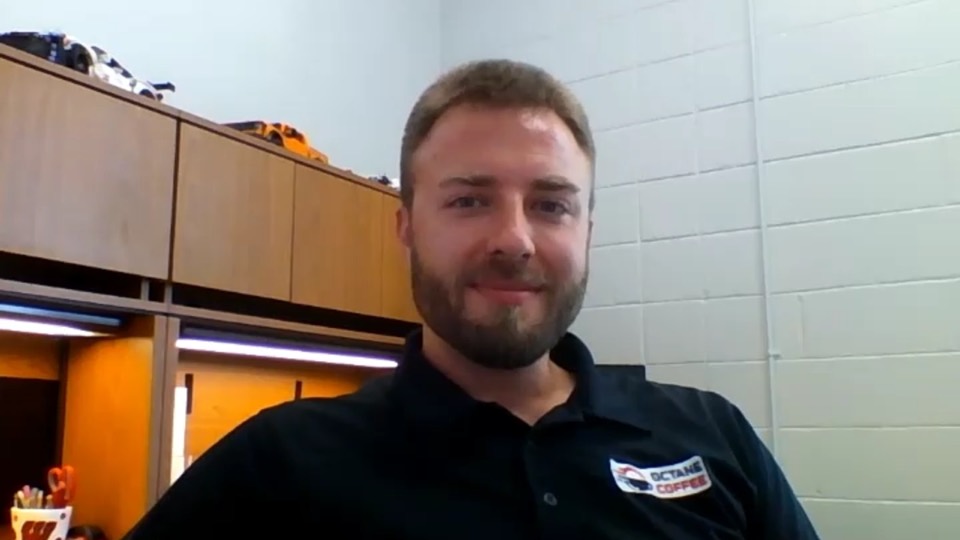
Adrian Deasy, Founder/CEO at Octane Coffee, is the guest on episode 61 of the Restaurant Tech Trends podcast, hosted by Justin Foster.
 Play episode
What Adrian and Justin discuss
- How Octane built a fully automated drive-thru from scratch
- The guest experience magic: GPS-timed drinks released so your latte is finished SECONDS before you pull up
- How Octane sloughs off the 20-30% labor line that every coffee concept carries, and why a 240 sq ft footprint lets them fit where a Scooters or Caribou Cabin (600+ sq ft) can't
- Adrian's read on the coffee drive-thru wars (Starbucks, Dutch Bros, 7 Brew, Scooters) and who he thinks has the most to lose
Also in this episode
- The "Powered by Octane" vision, why he partners with local roaster Stone Creek Coffee Roasters instead of owning the bean, and what the ideal early franchisee actually looks like.
- Adrian's first coffee of the day, his very basic PSL hot take, and what comes out of his mouth when the machine breaks at 2:00 AM
Episode notes from the host
This might be the coolest concept I've ever had on the show.
On today's Restaurant Tech Trends I sit down with Adrian Deasy, Founder & CEO of Octane Coffee, the world's first fully automated, employee-free drive-thru coffee concept. A mechanical engineer by training, Adrian looked at a line wrapped around a coffee kiosk back in 2018 and asked the question nobody else was asking: why hasn't anyone automated this?
80,000+ drinks served. Running 24/7. 200 drinks an hour at a single location with ONE daily service visit.
Thank you Adrian! This one is a glimpse straight into the future of beverages. Can't wait to have you back in a year to check in on the growth story.
Transcript
Full transcript (7,598 words)
Machine-generated transcript; names may be misspelled.
0:00 Hey everyone, welcome to Restaurant Tech Trends where we explore restaurant technology trends with some of the industry's biggest movers and shakers in a rapid fire short interview format. This podcast is produced by Incept AI. Incept AI takes restaurant orders over the phone and in noisy drive-thrus with friendliness and precision. Learn more at Incept.ai. My guest today is Adrian Deasy, founder and CEO of Octane Coffee. This is like the frickin coolest concept I think we've ever had on this podcast. I'm absolutely in love with it, Adrian. My co-founder is super in love with it too. Adrian is a mechanical engineer by training who back in 2018 looked at a line wrapped around a coffee kiosk and asked why nobody had automated it. Five years later, he opened the world's first fully automated employee free drive through coffee concept in Wisconsin. Today, Octane has served 80,000 plus drinks. It runs 24 seven and it pumps out 200 drinks an hour at a single location with a single daily service visit. Now he is eyeing a franchise launch. Want to hear about that as well, Adrian. Welcome to the show. Sounds good. Thanks for having me, Justin.
1:16 Absolutely. Like I said, this has been like one I've been super excited about for quite a while. Take us back to, I guess, the beginning of Octane. You saw this kiosk. What were you, you know, what were you seeing then that nobody else was seeing? What was the what was the vision and what prompted you to say, hey, I got to do this thing? Yeah. So I I'll take you back. So I grew up in food service industry. I grew up in restaurants. My mother managed restaurants for many, many years. And I jokingly say, like, I'll die before I go back. But there's something about the service industry that does bring you back. Right. So growing up in that environment, I knew I was going to be an engineer. My dad was an engineer. His dad before him. So I've always been in. I've always been interested in building cool stuff. So got into robotics, got into automation. I was the smart kid out of college. I could figure all this stuff out. So I got thrown to the wolves at a bunch of cool companies and through my corporate career and ended up building a consulting firm where I was building custom robot sales, machines, tooling, fixtures, jigs, manufacturing type focused. And it was always sad that I would build a project and then I need to find a new job. Basically, I worked myself out of a job. There was never going to be a machine number two, number three, number four.
2:33 Right. We've done all the engineering, all the wiring, all the plumbing and got it built. But there was there was no hope for there to be a machine number two. Right. So we kind of banded together and said, hey, let's build a business that is heavily automation focused. Let's use our skill set. But let's try to run it with as few employees as possible. And let's renovate an old kind of re-imagine an old either industrial or service style business. We went through a bunch of handful of ideas. We happened to be walking through a show in McCormick and saw the line for Starbucks up and around the Skyway. And I happened to make a comment like, why? They can clearly fill up a drive through. They've got good marketing and branding. The coffee's medium. You know what you're going to get. But why haven't they automated this? Like this experience of sitting and waiting for five, 10, 20 minutes sucks. Why haven't they automated it? So my buddy, who was raising a venture capital fund at the time, went behind my back, did two or three months worth of research. And he calls me and he goes, hey, that Octane, that automated coffee idea you had. I'm like, well, I wasn't I wasn't really an idea. I was just complaining. Right. Like someone should do this. And he goes, no, you should do that. So he ended up putting some of the first money in and we've been on to it since then. I love it. One errant comment turns into the last couple of years of my life. Well, let's talk about some of those early days, because I think it was maybe five years from the time where you had the initial idea until you opened, I think, your first location in October 2023.
3:58 What were you I mean, there's just a lot of stuff that's involved in this business, a lot of robotics, mechanical stuff, automation. What were you doing in those five years that you think most founders in your shoes would have skipped out on? Yeah. So I would say if you tried to go sooner. Yeah. So we we bootstrapped the first couple of years of the business. Right. Between his money and my money. So that it moved. I had other clients. I had other projects. I was doing other things also with the birth of my first children. So I was busy doing things like that. But no, it was the first few. Just think back to 2018. Right. Like we think it was so long ago, but it really wasn't. That being said, like you couldn't reserve a table on an app, let alone do a fully automated coffee drive through experience. Right. Like we thought we were going to drag people kicking and screaming into our vision of this fully automated future. So at the time, it was like, OK, well, everybody's carrying around a phone. Is the technology there? Is the GPS accurate enough? Can we get a robot to talk to a coffee maker, to talk to a major system? There was six or it was almost probably a year it took us to figure out the regulatory environment of like, what are we building? Am I building a cafe? Am I building a machine? Am I building a vending machine? Am I building a coffee maker?
5:19 Right. So like there's checkboxes and you got to do X, Y, Z. So no, there was there was many weeks and months spent just like, all right, I want to do this. I had the fuzzy idea in my head and it was going to be a fully automated coffee drive. There was going to be a big rectangular box in a parking lot. I wanted people to be able to order ahead from their house, from work, from school, from on the go, drive through, grab their drinks and drive away in 10 seconds or less. Like that was the original vision. Didn't have a brand name, didn't have colors, didn't have anything. It was basically like, let's do that. So we slowly built, we bought the first robot, first coffee maker kind of early 2019 and just slowly built all the little modules that you need to do. Right. So first it was just, can I make a coffee with a robot? Good. Can I put a lid on it? Can I put some syrup in there and make fancy lattes? Can I do cold drinks? Can I do this? That like you build all these little proficiencies. So by the end of kind of 2019 into like as 2020 was cresting, we had had, we built a four foot by six foot cute little vending machine effectively. It was going to go in the back of a coffee shop. We were going to partner with some local people. And all of a sudden, like they were dragging their feet. Things weren't moving forward at our pace. We ended up pulling out of the deal in November, 2019.
6:36 COVID struck the building that we were going to go into and spend another 15, 20 grand of our own money was shuttered for 18 months with COVID. So like thank our lucky stars that we didn't commit at that moment in time and that we did still have all the stuff and we were able to kind of refocus and rebuild. Through COVID, we saw the world shift to grab and go curbside, to go, contactless, drive through as king. And it really, and then all of a sudden app ordering became a big thing, right? Like that all got deployed and developed during COVID as a reaction to it. But now all of a sudden the customer is trained in that method of doing things. They demand that style of service. And we were behind the eight ball, right? So like that tech that we thought was five or 10 years out was now tomorrow. If you didn't have those things, you didn't make it through COVID. So realistically now, all of a sudden it was like, all right, hurry up, catch up. So we raised the first venture capital and angel money at that point. It was a $400,000 kind of pre-seed style round. Built out the first hardware. Like we were, I was not paying myself a dime for the first years of the business. So like things move slowly, right? I didn't have employees. I was literally one man band coming up with marketing, branding, working with the architect, getting in the container built, getting all the utilities, getting it certified, getting through city zoning and approvals, building the robot, building the coffee maker and all the things in between.
7:56 And then I finally had a guy that was helping me with some of the software. I can be dangerous, but you don't want me behind the computer. So that being said, lean on people where you need to. But that took, like there was a, there was a stall where we had bill permit in hand. We could do what we wanted to do, had money, could move forward. But then all of a sudden someone from the city was like, yeah, you're going to need to do X, Y, Z. And we're like, no, what are you talking about? They're like, we're not doing anything until the state tells us what to do. And that literally took eight months for me to figure out. It became welcome to the, we're from the government and we're here to help you. Oh God, don't ask a barber if you need a haircut. Do not ask someone from the government if you need their approval. It is not going to go well. So they kicking us down. Jack would say, that's not my problem. Call Mike. I'd call Mike. That's not my problem. Call Tony. And it literally was like telephone for months until finally I got the call. The guy's like, we're going to get it done. We're going to figure it out. And I'm like, that's my guy. And it still took him four months. You know, why did it take so long? There literally is not a game plan for anybody else on planet earth to build what we've built, to deploy it in the world with other people that need to sign off on it. Right. So we had to build that game plan from scratch.
9:12 So no, it took many, many years of just like, what have we built? And whose signature do I need on what piece of paper to make it happen? Yeah. I mean, I think any entrepreneur knows that the story is never always up and to the right all the time. You've definitely shared quite a bit of some of those early challenges, especially dealing with all these regulations. Was there ever a moment where you genuinely thought like, this isn't going to work? And if you did have that moment, what kept you going? Because I think a lot of people would have given up. I think I had five or 10 of those moments. And that's, that is the entrepreneurial journey. And that's one thing that someone like you or a viewer today might see me at this point in time and say, oh my gosh, it's just been sunshine and rainbows since 2018. This guy's got it all figured out. And like, that couldn't be further from the truth. Right. So there's been numerous, we signed big investment corporate deals and then legal got a hold of it and literally blew up the deal two weeks later. We thought we were good, golden, done, such is life. Right. We, we had a competitor all of a sudden get a, get a contract to be built. So they were going to scale out a cute little coffee robot. This was Brigo back in the day, now coastal coffee bot, but they signed a contract to be built at half hour down the road.
10:32 And I got a bunch of emails that was like, oh dude, RIP, like, I'm sorry, they're going to crush you. You're done. Good luck, man. And I literally was just like, I think they're full of crap. I think they're not going to pull off what they say they're going to pull off. And we were in a different market anyway. They were a cute little vending machine and we're full scale outdoor. Right. So I basically just said, nope, it is what it is. Welcome to COVID struck. That project got shelved, never completed, never built a unit. And so like, if I had just hung up my coat and said, yep, that's, that's it. I'm done. It, it was never even a competitor in the first place. Right. So it, you know, I have 10 stories like that where you sign a good deal and all of a sudden next week it's gone. You get the contractor, you get the newest location up and all of a sudden sales are down and you've got to bring them back up. So it's like, it is, it is the entrepreneurial journey and you just have to have an emotional stability, a willpower. And sometimes like, especially with this project, I've said many times that this is a snowball that I have had to absolutely push uphill this whole time. Right. Like there's a moment in time where a project like this gets a certain level of notoriety or a certain amount of respect.
11:47 Or just like a, everybody knows in the coffee industry, at least that I've talked to, this is inevitable. This is, this is the future, but they don't know if that's two months away, two years away, 20 years away. So everybody is on, in tune, happy, working towards it. But no one knows when this hits like a moment of legitimacy. And it's like, well, yeah, of course that's always been possible. Right. But until that moment, you got to push it uphill all the time. It's a, it's a weird time. It sure feels good when you're right though. That's for sure. Um, let's talk a little bit about the experience of what a guest, uh, experiences when they interact with Octane coffee. So walk us through what happens between the moment someone opens the app and the moment the window opens with their drink. What part of that experience also are you the most proud of and where are you still trying to perfect it? Yeah. So we know typical daily customers, right? People have been with us two to, I think we have a couple of customers that are 400 times that come through the drive-thru, right? So like there's some good seasoned veterans in there. Typically they're ordering ahead from home, school, work, errands, the gym, they're on the go. They want to grab a coffee. They know they're going to come past our location ordering ahead.
13:03 We start pinging their GPS on their phone. We know in the backend how long it's going to take to make their unique individualized drink. If it's got syrups, if it's got ice, if it's got sauces, if it's got cold foams, like we know individual time measurements of every single drink. We know the load in the system, how many other drinks are being pushed around and moved. And we can say with reasonable accuracy, we're going to release the drink when they're roughly two ish minutes out, right? So like all of these are uniquely timed to the second so that it's being released. It's being made, whether it's hot drink, cold drink, it is being finished in the window and a robot is quite literally placing it as you are pulling up. So it is the freshest, absolute freshest hot lattes, iced coffees, energy drinks, lemonades, teas, sodas, fully customized. But it is happening, finishing seconds before you arrive. Customer pulls up through the drive-thru. We have two Samsung 55-inch screens out there, kind of like a menu board, right? But we use it more for customer communication. You'd look for your name on the bottom of the list. If it's being built, if we're still finishing a couple of details, there's a progress bar that's being built. And as soon as it's finished, it's like, hey, pull forward, Justin. Yeah. You pull forward to the window. You scan the QR code that's generated in the app as your receipt page.
14:18 You scan your drink or scan your QR code. The window rotates around. You grab your drinks and you drive away. We are actually working on what we're calling internally magic window, where we don't even have your QR scan. So you just literally roll up. It knows you're there. We rotate the window. You grab your drinks and you drive away. We have a couple of customers beta-ing it for us just to make sure that it's really good and accurate. And for us, it is a big no-no to hand off the wrong drink to the wrong person, right? We've never done it in, like you said, the 80,000 plus drinks that we've made. We have never delivered the wrong drink to the wrong person. So it is imperative that we don't do it now and start making problems. Because if you hand out the wrong drink, they didn't get what they wanted and you actually gave away someone else's drink. You screwed up two orders. Massive no-no for us. So, but no, it's quite the experience. Inside our Generation 2 architecture, we've got four industrial robots. We've got a bunch of other cool tech, lots of off-the-shelf equipment, right? So coffee makers, refrigerators, ice makers, soda fountain, vending machine. There's a bunch of stuff in there that you would generally see at a cafe, at a restaurant, at other food service operations. So it's like it's good premium equipment that we've slapped our brains into.
15:34 And we're definitely taking over control and being able to make very customized drinks that this equipment was never originally destined or capable of, right? So we've added a lot of brains and smarts to things. So two questions for you. One, describe why you came out with the Gen 2 architecture. What exactly is different there compared to Gen 1? And then the second question, a little bit unrelated, is do you have any plans to open up the ordering point at the location as opposed to through the app and why or why not? So potentially. Okay, so zooming back in time. The shop that we launched in 2023 was what we call Generation 1, right? It was literally a hand-built labeler of love, blood, sweat, and tears. I built the whole thing. Quite literally, I laid the flooring. I did the insulation. I did all the wiring and conduits and like it was quite a task. So that being said, it has the old Generation 1 architecture had one robot inside. His name was Frank. So he's still around. He's still with us, Frank the robot. But he basically was handling anytime a cup was moving in the system, he had to touch it. So that being said, he became the bottleneck and like the throughput throttle. We could only make 50 to 60 drinks per hour.
16:50 But there just wasn't enough stuff moving around all at the same time to flush out that many drinks. That old prototype location ran fine like that. It ran two, two and a half years, 24 hours a day, seven days a week with that architecture. And so things every now and then were a little slower than we wanted. We lacked some modularity. We wanted to be able to swap equipment and a new module or a new... We wanted nitro cold brew. We wanted cold throngs. We wanted extra stuff. And there just physically wasn't enough space. So we went back to the drawing board in 2024. Now that we've got kind of proof of concept, hey, this works. The hardware architecture works. The software needed a couple updates to be able to make it. But then as we got into Generation 2, it was like, let's turn this up to 200 drinks per hour to drink every 18 seconds at the window. That's as fast as you can flow a single lane drive-through. So realistically, that became the target and we're still pushing to hit that. But now you break down the process into what can you do in 18 seconds and hand it on, kind of like an automotive manufacturing line that I used to work with Chrysler and Harley-Davidson back in the day. So it's a very cool new product from that perspective that it's way more bells and whistles and features, much more serviceability, much more modularity. And it's a good, stable platform that we can build for the next 5, 10, maybe 20 years.
18:08 So as you had mentioned, like our ordering flow is typically through our app because it gives us the best level of control. We do have a handful of technologies in the back end that we've rolled out a couple times and rolled them in, rolled them out. We've got an ambassador-style ordering so we can be on-site with humans and kind of work the line and order for people. We've got that technology. We also tentatively have the – like you could do an AI ordering. You could also do like a human on a camera sitting in an office talking to someone through the drive-through screens. And we're trying to push people towards more so of that modern app ordering that we see ubiquitous at a Starbucks, at a Dutch Brothers, at Dunkin' Donuts, right? So we're trying to push people that direction to give them the control and that power rests in their hands, right? In their device rather than more of that old-school method. So we believe that there's definitely an opening and an opportunity to do it. It's just it hasn't been a focus yet. We've been so kind of heads down and focused on just making the thing work, making it survive, making sure we can maintain it, making sure our drinks are tasting good and new menu items are continually rolling out that we'll come back to it, right? Like it is certainly a topic. Like do we lose five, ten customers a day that want more of that traditional walk box, talk to somebody, order it, get ahead and go and pay?
19:33 Anything is possible. We just haven't quite figured out how to replicate that in our current format. Makes sense. So if I were to sum up your two answers, it would be throughput and control. Yes.
19:46 All right. I want to talk a little bit more about your model. I think one of the things that is a bit interesting about you guys is that you're not trying to own the coffee, right? Starbucks, of course, like has their own coffee. It's their brand. What made you make the decision to partner there as opposed to like owning the coffee itself? Yeah. So being a small brand that we are, right? One, we've got a couple locations that we do. We're still small scale. We're still very local. For us, we wanted to lean on the reputation of somebody else in the area that already had really good, well-established roasted beans. And just like that, that was not part of our integral strategy. At a certain point, we knew we were going to get to franchising and get to nationwide scaling. And at a future point, there may be bringing either roasting back in-house, working with a large national roaster, white labeling it, becoming Octane Coffee at some point, like internal branded. But for those first couple years, we definitely were able, like, and still are, still love our partnership with Stone Creek Coffee up here in Milwaukee. They've been in business 30 plus years, well-known in this area, having some of the best roasted beans.
21:02 So for us, it's like, it's a great partnership. It gives them some more cool visibility, some cool marketing, some other people that they don't have any drive-thrus, right? That's not core to the Stone Creek Coffee brand. So now somebody, busy mom, busy parent, they got kids in the car or the executive, somebody going through the drive-thru quickly in the morning, they can still get Stone Creek Coffee but not have to go and sit down at a cafe. So, like, we're not competitive. We're actually more symbiotic in that way. But no, they've been an amazing partner for us. We also work with a lot of other vendors and partners in terms of our cold coffee stuff, our energy drinks, lemonades, teas, sodas, right? Like, there's so many different vendors behind the scenes. We love to work with local whenever possible. Our dairy is locally, a local dairy here at Marigold.
21:53 But good premium ingredients, great vendors, and making sure that we've got the best taste in the cup. I love it. Well, you kind of teed this one up for the next question, which is coffee drive-thrus. I'd want to just take a quick step back and look at, like, industry as a whole. Right now, you've really got the coffee drive-thru wars are, like, in full throttle right now. You've got, of course, Starbucks. You've got Dunkin'. You've got Dutch Bros. Seven Brews, like, really hot right now. Scooters. BlackRock. From where you sit, what does the average drive-thru experience look like for coffee in, say, five years? And of those brands or others, who do you think really has the most to lose?
22:41 Most to lose. So we'll start there. I believe Starbucks has definitely got the most to lose. They're still the 1,000-pound gorilla in the room, right? Like, they are still the big boy. They've got a lot of brand power. They've got a lot of cool marketing. They've got a good, stable footprint. And they're growing slightly. They're not growing crazy. The newer up-and-coming, right, so call it a Dutch Bros. It's obviously been in business 20 years. They've been doing well. They're corporately owned. They're holding things tightly but expanding rapidly, as opposed to Seven Brew, which definitely had, call it the last five or ten years, local, small, and then have exploded in the past. Realistically, we think that the consumer is changing from a typical lattes, black coffee-style espresso shop like Starbucks to iced-focused, right? Like, Dutch Bros. is 80% to 90% iced. Seven Brew, I would assume, is right up there. They've just got a very different way of doing things. And so, you know, those concepts have been growing crazy, crazy. So I would say our emphasis and our model of, like, who is a successful coffee shop these days, back in the day when I did Generation 1, it was 100% Starbucks, right?
24:02 It was, let's make sure that we've got the same menu, the same capabilities, and this was, call it 2018 to 2020. Cold coffee, iced coffee, cold brew, that nitro, that sort of stuff was maybe 5% or 10% of a menu, right? It was not a big portion of what they sold. Right. As opposed to fast-forward into this day and age, I want to say it's something like 80% of Starbucks is cold or iced. Dutch Bros., those guys, like I said, maybe 80% to 90%. It might even be crazier than that. So there's other concepts, swig and sip and other things that are even non-coffee. But think of it in terms of it's energy in a different format, right? So I'm 36 years old, proud millennial. Gen Z, Gen Alpha coming into their kind of caffeine drinking era, right, their new lifestyle, they're sometimes non-coffee, like exclusively. They love energy drinks. They love teas. They love sodas. They love other stuff, but they aren't necessarily – they're not going for a hot latte. That's not their thing. And so you have to have – you've got to have something for everybody. But at the same point, you have to see where the industry is shifting.
25:08 That being said, we think that we're very competitive in this environment for a handful of reasons. Obviously automated labor is a massive problem for every bar, restaurant, cafe, anybody out there. Like I don't believe they're hurting for sales. I don't believe they're hurting for volume. I don't believe they're hurting that way. But they certainly have – I've heard the other day someone said they had 100% turnover. Every year they literally have a brand new staff of people. So the local Seven Brew around us, love them to death, they do awesome work, has 60 part-time girls that work at one location. Yeah. 60. Yeah. Imagine – imagine drama anyway. We also – from a footprint standpoint, my building is 240 square feet. The smallest competitor out there that we've ever seen is like a Scooters or Caribou cabin. They're 600 square feet. Yeah. They're still double and triple the size that we are. So we can fit in places in between these other shops that have – I don't know if you've been to a Seven Brew lately. The one around here has a 10-minute line easy because sometimes it's a two-hour line. It isn't possible to flow the amount of people that they think they've got, right? Yeah. Starbucks routinely is a five or 10-minute around here.
26:26 And this is Milwaukee. We're not crazy big scale like some other places. But we think we've got a cool competitive product that runs with little to no labor in its tiny footprint that we can fit in parking lots. Okay. So I want to lean into the labor thing, right? Because I feel like labor is like the big elephant in the room for pretty much almost every restaurant brand that I talk to. It's a huge cost. It's a massive cost. I'm out here in Seattle. I think the fully loaded employee cost is something like $28 an hour. Southern California, it's even worse than that. You've built a model that basically runs employee-free. You do have the 30-minute service visit every day to stock up the location. It seems to me like everyone would be trying to get into this. Tell me more about the economic profile and what that is unlocking for you and how you think that's going to help you scale your growth. Yeah. So if you look at – we like to benchmark ourselves because obviously we're planning to go into franchising. So we're always looking at publicly available FDDs of other coffee franchises. Yep. So we're looking at Duncan. We're looking at Seven Brew. We're looking at Scooters. We're looking at a handful of others and trying to figure out like where do we benchmark ourselves? Where do we want to fall in terms of upfront costs for building out a site, building out equipment?
27:46 How do you loan on that? How do you work on that? But all of these, without fail, have a 20% to 30% and sometimes even higher labor line built into their model. Right? It is just what it is. That's how they run. That's how they make their money. They need labor. Otherwise, drinks don't go out the door. So we are able to kind of flip that model on its head and say, hey, we've got a lot of cool automation that can eliminate most, if not almost all, of that labor in the model. How can we put more money in pocket of a franchisee at the end of the day and have such less headache? Right. So obviously using 7Brew as that big example, it's like, well, how much are they going to invest building a 7Brew, hiring all these employees, managing turnover, just trying to get people in and working and doing things during the day? But how much money are they going to make at the end of the day, at the end of the year, like at the end of the whole thing and saying like, well, let's give you a lot less headache for a lot more benefit. So we're trying to make sure that we are benchmarked that way. Okay. That makes sense. Well, let's peer into the maybe distant future, maybe near future. I don't know. You tell us. You talked about a long-term vision that includes drone delivery to moving cars on the freeway.
29:03 Definitely an interesting idea there. So let's put aside the regulatory. It is the pinnacle of convenience. So you've got to go through that exercise of like, what would be the absolute pinnacle? And then you kind of reverse engineer and you build it backwards and say, okay, well, what would you need to do that? How would it even be possible? And then maybe there's the obvious regulatory safety, just sound, right? Like I get it. But that is the 100% pinnacle vision. How do you make steps towards it or get most of it? Right? All right. Well, clearly we're moving toward a more automated future. I think that vision is peak convenience. You're definitely a step on the way there. Let's talk a bit about your franchising plans. So I think you've mentioned you're just starting to franchise. Yes. We are so, so, so early. So I don't have any major big details. Our franchising partner is going to be the DX3 Group out of Tampa, Florida. So they've got a good successful. They've been franchising for 25 plus years with a different concept. And they've been looking for a brand number two, a brand number three to kind of help bring through those early years.
30:19 And franchising is crazy. There, there's a lot of support systems and consultants and attorneys and different groups that you can work with, FSOs, franchise sales organizations. And it's just like, it's a, it is a crazy, hectic world to take a concept like ours that doesn't have all the traditional trappings of a normal business. Well, yeah, you're going to hire Joe Schmoen. He's going to drive around on a truck and you're doing the next Mosquito Joe style thing, right? Like our model is so different that it's hard to conceptualize sometimes for them. And, and it also comes into just proof in proof of concept, right? Like you need to have extended runtime. You need to have months, if not years worth of data on multiple locations, making sure that the unit economics, everything is sound. Like it's hard for a startup like us to reach that moment of legitimacy. And that's, we've been taking baby steps and I think we're, we're very, very close, but it takes a lot of time to build something that is franchise ready. It's a, it is a system, right? It's a business in a box. Well, we're selling the business as a box. Okay. Well, that'd be what it is. Tell me like, what is the ideal profile for a franchisee?
31:35 Is this like a tech forward entrepreneurial, someone that's been involved in robotics in the past? Is this someone just like leaving corporate America? That's looking for a hot concept. It's a single unit, multi-unit. Like what is, what does it look like for you? I would say our ideal, at least in the call it first year to two is definitely an experienced operator that knows what they're doing. Hopefully they've got experience from other similar, if not unrelated concepts that just, they've got organizational system level thinking, right? We don't expect them to be rocket science, engineer, troubleshoot everything. What we've built, while it sounds crazy complicated, we have put a lot of thought and investment into how do we make this intuitive? How do we make this understandable for most people to use and operate on a daily basis? How do we use as much off-the-shelf equipment as possible so that when the soda fountain pump breaks in the middle of a Tampa, Florida summer, that they can just call a local soda repair tech and he'll have the tools and the fittings and everything on his truck and be able to fix it, right? So there's been a lot of thought put into how do I use standard technology that anybody can fix while at the same time anything that is crazy, custom, complicated, we're on the hook for and we need to make sure that it is absolutely bulletproof.
33:02 From a hardware perspective, from a software perspective, from a spare parts, from a consumables, from a maintenance, what do you do on a weekly basis, monthly basis, quarterly to keep preventative maintenance moving so that you're not going to have problems? You're not going to have failures. So there's a lot of things there. But no, from a first initial perspective franchisee, the romantic notion about someone coming out of corporate America and just taking a five to ten year hiatus and running a coffee shop is really appealing to people. I've talked to, I don't know how many hundreds of people that I've heard that same story from. Of course, none of them go into this and say, yeah, I really want to hire five to ten part-time kids and do this thing, right? Like that's not what they say. And then if you've talked to seasoned operators that do have five, ten, twenty – I talked to somebody the other day with 1,800 employees and it was like, yeah, no, yeah, no. So they get it, they understand it, and there's an immediate like, oh my god, if I had something like you back in the day, I would have been all over that, right? So like there is a knowledge and there is a wisdom in guys that have been operated five, ten, twenty plus years and now have seen what that takes and what that is.
34:25 And some of them have made decisions and like, yeah, when this is ready, I'm out. I'm done. So we've had those conversations. Yeah. All right. Well, we're almost out of time, and I want to wrap up with talking about the Powered by Octane idea. So first of all, tell us what it is, and then how do you really see that playing out? Do you think potentially Octane could be more valuable like as an infrastructure layer in existing coffee shops or restaurants than as a brand? Or is it complementary? Or just tell us where that's going. I'd say it's relatively complementary. All right. So back at the earliest day, we figured a Starbucks, a Dunkin', a Caribou Coffee, some big coffee company was going to snatch us up for our technology. We figured that was going to happen. And we've had conversations with a handful of the big boys. We know where their head is at. And I just think that we had to build it, and they will come. We had to build something that was impressive and big and full scale like we have built for the turnkey drive-through units. And that's definitely much more of a franchise-style play. So we've got a good partner there. Like I said, the DX3 Group out of Tampa. They're going to be helping us with marketing, branding, legal, real estate, sales, all these missing pieces.
35:43 We're a very good engineering company, but we don't necessarily, just humbly, we can always be better. So they're going to fill in a lot of those gaps in our program. But it's also that's good, stable, scalable technology that they can run with. We can build in service and support. So we've been looking for other verticals, other places that the technologies that we've developed, some of the automated tech, the robotics, the software behind the scenes, what other places could it power by Octane in existing, like a retrofit style for an existing cafe, an existing restaurant, food service applications, bars, stadiums, universities. Like we're looking at other places and saying like, well, we've got the tech. It works. It's bulletproof at this certain level. What other things can it do? Can we squeeze it, stretch it? Can we fit it in different places where instead of being inside of a shipping container out in a parking lot, it's inside of an old bank drive-thru or an old car wash and an existing cafe that the space is there. It's all plumbed, wired, ready to go, but they couldn't staff it. So they couldn't keep that cafe at a business park or a school open. We can now go in and be a viable alternative that can run and can work.
36:59 So it's like we were looking for other avenues, other verticals that we can launch our technology into. Thus, that kind of power by Octane. If you were to say like if you are to look at like the near-term strategy, like is this like 50% of the near-term strategy, like 10%, 5%, where would you prioritize it? I would say right now it's probably somewhere in the 15% to 25%. We've got a handful of partners that we're in discussions with. We're trying to figure things out. We're like those will be the early pilot style projects, right? We're going to be learning alongside them. We're going to be subsidizing. We're going to be learning a lot of lessons with those first early partnerships as opposed to I would say today I don't have a product that would be like, here you go. It's yours. It'll run tomorrow, right? Like we're still in that kind of R&D style phase as opposed to the drive-through stuff is turnkey, ready to go. So like we are ready to scale that and that's definitely going to be a lot of time, focus, growth over the next 6 to 12 to 18 months. Definitely heavily focused there. Well, I definitely would love to have you back on in a year and check on the growth story. It's super exciting what you guys are working on. Thank you. But Adrian, we are actually out of time for our regular questions and it's time to move on to our rapid fire segment of the podcast.
38:19 Sounds good. So for everyone that's watching or listening, Adrian has no idea. These questions are that I'm about to ask him. The rules of engagement, Adrian, are try to answer each one of these questions with one word if you can. And if you can't with one word, try to keep it to one sentence. Are you ready? Okay. All right. First coffee of the day. A real cup or are you loyal to the machine?
38:48 I do cold brew at home. Cold brew at home. All right. Let's get your hot take on this. Is the pumpkin spice latte a masterpiece or a menace?
39:02 I'm really basic and I love it. All right. What is one word for the sound of your Gen 2 hardware running at full tilt?
39:16 There's a whir. There's a whir in there. It's a whir. All right.
39:21 Engineer brain or founder brain? Which one keeps you up at night? Definitely founder.
39:31 What is the most underrated coffee order that no one appreciates?
39:44 Black coffee is really difficult. It can be complex and people don't know how complex.
39:53 Let's keep this next one, PG. Okay. The machine breaks at 2 a.m. What's the first thing out of your mouth?
40:05 Again?
40:08 All right. It was definitely a swir. That's after.
40:12 I like it again. Thank you. I don't know how many kids we have watching this, but, you know, sure people will appreciate it. Finish this sentence. In 10 years, the drive-through is blank.
40:27 Faster. All right. Adrian, I really want to thank you for sharing the story of Octane Coffee here with me and with us today. Again, I think what you're working on is so cool. It's so exciting. I definitely believe this is going to be a big part of the future of beverages and in coffee. And I just love to see innovation like this in our industry. I would love to see you at another dinner in Chicago, any of these, like, industry events. But I want to thank you for your time here today. Everyone, Adrian Deasy, founder and CEO of Octane Coffee. Thanks for having me.