Episode 80 · October 29, 2026
Deric Rosenbaum
President & CTO · Groucho's
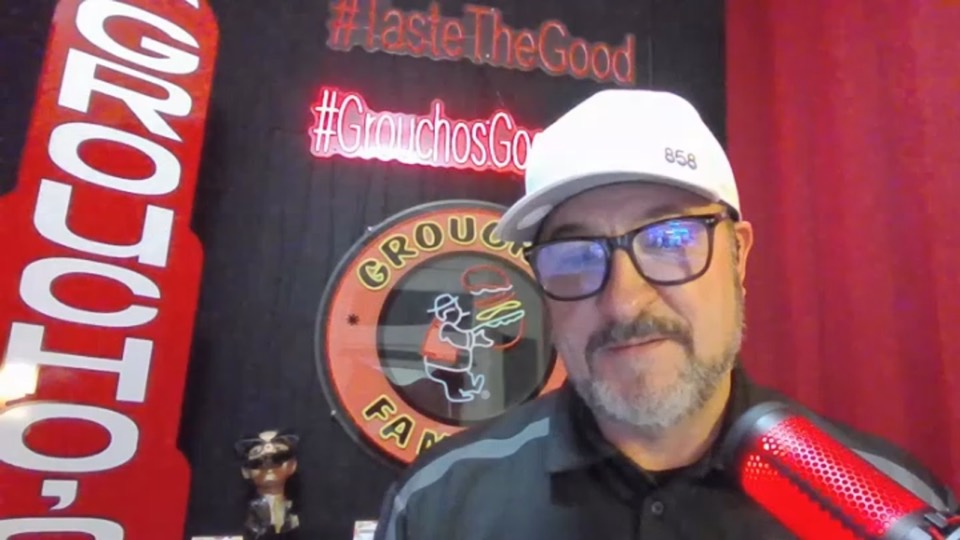
Deric Rosenbaum, President & CTO at Groucho's, is the guest on episode 80 of the Restaurant Tech Trends podcast, hosted by Justin Foster.
 Play episode
What Deric and Justin discuss
- How a single omni-channel menu plus a brand "ontology" became the foundation Groucho's now benchmarks EVERY tool against, because no GM is logging into 14 dashboards
- The MCP-powered synthesis layer that lets his team chat with the restaurant, plus custom weekly franchisee reports and AI pre-inspections
- Why par sheets, recipes and truck orders now show up right on the KDS, and the plan to put Groucho's own AI agent on that screen too
- What a survey to 150,000 guests told him REALLY mattered
- Why you will never see a robot (or, for now, a kiosk) in a Groucho's dining room: "breaking bread is inherently human"
Also in this episode
- Deric's take on the most overhyped tech in restaurants, and the FSTEC pitch he says is "a great way to get sued"
- Rapid fire - STP Dipper vs. Slaw Reuben, hard hat vs. apron, President hat vs. CTO hat, the best sandwich he's ever had that isn't a Groucho's, and the one word that keeps a deli going for 85 years
Episode notes from the host
PE Truth Bomb: "Saying no to fast money is pretty easy when 1941 is your benchmark."
Today on Restaurant Tech Trends I sit down with Deric Rosenbaum, President & CTO of Groucho's Deli, the Columbia, South Carolina neighborhood deli turning 85 this year with 32 locations across the Carolinas and Georgia. Deric came over from commercial construction in 1999, recruited by his best friend and third-generation owner Bruce Miller, and still builds tech like a building: foundation first. He also sits on Square's Food & Beverage Customer Advisory Board and Marqii's advisory board.
Huge thanks to Matt Wampler for the intro. Deric is as tech-forward as they come and still all about people.
Shout outs to Square, ClearCogs, Bikky, Fresh KDS, Marqii, and Ovation for the best-of-FIT (not best-of-breed) tech love along the way.
Transcript
Full transcript (7,945 words)
Machine-generated transcript; names may be misspelled.
0:00 Hey everyone, welcome to Restaurant Tech Trends where we explore restaurant technology trends with some of the industry's biggest movers and shakers in a rapid fire short interview format. This podcast is brought to you by Incept AI. Incept AI takes restaurant orders over the phone and in noisy drive-thrus with friendliness and precision. Learn more at Incept AI. My guest today is Deric Rosenbaum. Deric, I didn't know that Deric was around until just a few weeks ago. I was chatting about him with my good buddy, Matt Wampler. And here we are. We're on the pod. I'm super excited. He's president and chief technology officer of Groucho's Deli. The Columbia, South Carolina Deli Harold Groucho Miller founded in 1941. This year Groucho's turns 85. That's pretty insane. Don't encounter too many brands that have been around for that long. 32 locations spread across the Carolina. And Georgia. Deric came over from commercial construction in 1999. He was recruited by his best friend, third generation owner, Bruce Miller, to help build the restaurants. And since then, he's rebuilt the brand's tech stack around a single omni-channel menu. He also sits on Square's food and beverage customer advisory board, along with Marqii advisory board. And he's part of the Fairpact Alliance. Deric, welcome to the show.
1:30 Hey, Justin. Thanks for having me on, man. Excited to riff today. I'm pumped up, man. It's going to be good. We're going to have a good time here. You know, I got to ask you about the background in commercial construction. I know it was a while ago. 1999. We're not spring chickens anymore out here. Negative. But you opened up the first couple, first few restaurants, first franchise restaurants. Were you actually the franchisee at that? I was the franchisee. Yeah. Oh, okay. All right. Great. Yeah, that wasn't totally clear. And now we're doing building of a different variety. So tell us about the path, how you got from like sticks to building tech. Yeah. I mean, at the end of the day, it's, you know, people that understand building and construction can look at a piece of paper and know what it's going to look like at the finished process. And, you know, I have the ability to know where we want to be and then how do I connect the infrastructure to get there. And basically the architecture required to get to that end goal. And, you know, the end goal is constantly moving. But so it's allowed me to to bring those processes we used to, you know, everything in construction starts with the foundation. Right.
2:46 And if you don't have a strong foundation, everything you build on top of it's going to fall apart. So we kind of brought that same approach around building a singular omni channel menu. And then we spent the last year building a digital ontology of our brand and layering all the semantic data and a canonical glossary. So, you know, now we have these two foundations that we can benchmark everything against. And then bring in specialists like you mentioned, Matt Wappner earlier. So we're doing supply chain automation with ClearCOGS. We do a lot of work with Bicci and other groups. And then so now we have built a synthesis layer using MCPs to connect all of that into basically a global view of our org. And now we can chat with our restaurant in a holistic way. That's awesome, man. We're definitely going to dive a little bit deeper into the stack that you've built. I'm curious. You mentioned a lot there. So we're absolutely going to touch on it. I did. I want to ask just one more thing, though, about your position, because not only is it unusual that you have this background in commercial construction, but I don't think I've met someone before that is both president and chief technology officer, right? Normally, when I think of technology, even though this is maybe a bit of an old-fashioned view, I think of technology as a supporting function of the business, even at the executive level.
4:08 I don't think I've ever met someone that's like both doing the tech and is running the business in like one hat. So like how does that work exactly? And what advantage does it bring to Groucho's having you do both? You know, I started out as an operator, right, and learned that side of the business and learned the distribution side of our business and then sort of morphed into this technology role. And I think it keeps me grounded because I look at it through all lenses, especially from, you know, an operator's lens. You know, change resistance is super real and very natural. And so we bring a very methodical approach to tech rollout. And, you know, we do a lot of due diligence and operational order flows, really, through, you know, and testing and vetting and deploying our own locations first before we roll it out to the chain. So I think it really just gives me a more holistic view of how to run the business. I see. It makes sense.
5:19 Let's talk a little bit about this methodical approach that you take to evaluating technology.
5:28 There's, I mean, you can just walk around any of these trade shows, right? You go to RLC, FSTech. There's like every vendor out there. AI this, AI that. There's all kinds of like little shiny toys. How do you... .ai today.
5:44 Everyone is, everyone's .ai, including us. But how do you prioritize in this type of environment? And when you're evaluating a new technology, how...
5:58 First of all, how do you decide upfront, like if it's real? And then once you start testing it, are you of like the fast fail mindset? We're like, oh, we're going to put it in for like 10 days. If it doesn't work, it's gone. Or do you take a different approach? Or does it just depend on what it is that you're looking at? I think ultimately it depends on what we're looking at. And I think like most other brands out there, we just onboarded all of these things during COVID to like fill these voids and do what we needed to do to capture business. And then you get into like 2023, 2024, and you realize, okay, this is just far too much to manage. Like no general managers going into 14 dashboards. Like this is just unrealistic expectations. And if you look at, you know, the biggest complaints in our industry are accuracy, right? And accuracy has just two sides of the coin, product accuracy and timing accuracy, because we're north of 50% off-prem. And, you know, when a customer selects 1210 for their pickup time, you have made a micro promise to them, right? Right. So I think ultimately what it boils down to is are you open and agnostic, especially when it comes to APIs? You know, for years we did scraping and web hooks and all the things that we had to do before the tools that exist today.
7:18 And I mean, ultimately the reason we chose Square for franchising is because it's completely open and we can connect the partners that we want to connect via API. And it allowed us to build that singular omni-channel menu.
7:31 And that has eliminated a lot of the pain points we've had around accuracy and pickup because we studied all the things. And yeah, I mean, we're constantly failing forward is how I look at it. And, you know, so now we're getting very methodical into who we pick and who's solving for what we're trying to achieve. And, you know, we do thoroughly test in lab and then we will deploy in a single store and vet it out. I mean, you mentioned Matt Whomper. We tested it in five locations and thoroughly dialed it in and they learned the nomenclature of our brand and how we operate and, you know, how we think about product and packaging and prep. And that's the kind of vendor partners we're looking for, you know, that want to be – I'm looking for long-tail vendors, not, you know, a flash in the pan. And, you know, I've been around long enough to know the difference between vaporware and real product. So, I mean, generally at the end of the day, that's how we think about it. And, you know, we are going to make the decision that's best for our brand and our brand's objectives. And I tend to lean towards best of fit, not best of breed. Okay.
8:47 Yeah. I am also curious just to talk a little bit more about the overall platform consolidation trend that's going on out there, but Square specifically, because I do believe you are also the first person that's been on this podcast that has deployed Square at the scale that you're at. You're over 30 restaurants right now. I do know Square is looking to push upmarket, you know, probably a little bit further behind Toast and their push to go upmarket over the last few years.
9:20 But I would – I personally agree with you. The best part of Square is how open it is and how easy it is for outside vendors to integrate. Are you actually providing, like, a single Square login to your franchisees or are GMs logging into Square to, like, see, like, how all these different systems are performing? Or do they still have to go to, like, all these different tools to, like, for, you know, the forecasting stuff, like what ClearCOGS is working on? Maybe not specifically them. I'm not calling them out. But how is that – so there's a platform consolidation. We talked about bolting things onto Square. Single view. Like, where is Square in this journey from your perspective? Sorry, that was, like, five questions in one. That's all right. I got it. I got you. You know, at the end of the day, Square is our source of truth, right? It is the source of truth when it comes to our menu. I mean, that's where our menu resides. It is the source of truth. It feeds out to every channel from the Square dashboard. So it feeds DoorDash, Uber, GrubHub, our native first-party digital. So all one menu toggled off and on based on how it's served and where it's served.
10:28 And then we – with Square for franchises, we set up an orchestration layer. So that master menu sits at the top level and matriculates down to all of our franchisees. They can control their pricing because clearly you can't do that in franchising. But we control the descriptions, the SEO, the images, all of those things. And then this is also where we do our orchestration around gift card and loyalty for the whole chain. So they're kind of the source of truth of all of that. And then with their OpenAPI connections, we bring in best-of-fit partners. So Marqii digesting our menus, then pushes that out everywhere across the web. So Bikky is pulling in all of our transactional data from Square. So then we get all the contextual data. So then we can do our segmentation and our marketing. And then, you know, ClearCOGS you mentioned. Yeah, so ClearCOGS, we don't even really have to have a dashboard because the way we worked with them is we integrated them with another partner, Fresh KDS. So our teams don't even have to print. When they come in in the morning, their par sheets are sitting on the KDS, ready to check off. Recipes are ready to check off. Their truck order is sitting in another tab on that KDS. So, you know, a big learning from that project is, you know, bring the results to where our teams already are.
11:44 And we're already in KDS all day. So it just made a lot of sense. And, you know, with Square, they have an enterprise API. So when I connect a partner, if they're structured correctly, the partner is, then I just connect them once and then they have access to the entire org. Have you run into problems as you guys have added units? I know you've chosen more of a, at least from what I read, more of like a controlled build out. You're only adding, I think, like a few units a year. Feel free to correct me if I'm wrong on that. And as you've added and grown, have you run into any scalability issues with Square or have you partnered with them to like address gaps that you've seen? We partnered with them to address the scalability issues we were having. I mean, we were on a cloud-based solution before, but they didn't want to play in other people's sandboxes. And they didn't want other people playing in their sandboxes. And, you know, Square, that's not what Square is trying to be. And they've just allowed us to grow the way we want to grow. All right, cool. I love it. You know, there's a, it's a big C out there. And I like to see, you know, lots of players having success. Unfortunately, there's a lot of POS providers out there that, you know, they'll give you API access, but you got to pay a tax. And, you know, every connection we have, every connection we have, I've made it.
13:03 Like, I don't have to call anybody. We just do it. Yeah.
13:08 I definitely, we're not going to use this to throw shade at anyone, but I'll just make a general comment. Some of the legacy providers that are out there just don't get it. Like, they just throw up so many barriers and obstacles that make it difficult to connect the systems that you need to have connected. And the stupid, silly fees and the, you know. That's a legacy mindset. You know, business units that have to talk to one another to try to figure it out. I mean, it's just, it's, you know, as a vendor, I think it's kind of insane. So. Pass on. It's a legacy mindset.
13:45 Yeah. Well, when we, when we went up with our first one, our first customer was a food truck. It was square. Why was it square? Because it's nice and open and nice and easy.
13:57 Let's talk a little bit about your growth. So 32 units. This is what I would call like a tweener brand. I think it's like a really exciting size because you've, I think, are way far ahead of where most brands are that are your footprint. But you have an opportunity to like really build the foundation for scale. Why are you guys not growing faster? I mean, I'm sure you could. And then this is around the time private equity starts to pop in a little bit. You're just like, eh, not going to do that. Like, why are you choosing this growth path? I mean, for us, saying no to fast money is pretty easy when 1941 is your benchmark. Like, you know, the fourth generation, Bruce's son now owns two franchises down in the low country of South Carolina. So, I mean, it's just we believe in community and we believe in quality. And we want to instill that and we want franchise partners that live and breathe that and operating partners. And it's just it's hard to do that when, especially with VC or private equity money, when everything is driven by a balance sheet and a P&L and how do we extract more from less.
15:18 And that's just not who we want to be, man. It's just control growth is our modus operandi. I mean, in a perfect world, we'd like to do a store a quarter. But that's not hard, fast, set in stone by any measure. Like, it's just when it makes sense, we'll do it. If it doesn't make sense, we won't. And the new stores that you're adding, are they company stores or are they franchised?
15:43 We had one new company store last year. We just did our first license agreement with Aramark on the University of South Carolina. So that's been new for us. That just opened up in August and it's been gangbusters. But it's been a huge learning curve. And then, you know, we have another franchisee that's getting ready to open a third location in January. So it's predominantly franchised would be the answer going forward. And are you looking for, as you look for new franchisees, are you looking to grow with your existing ones? Are you looking for multi-unit operators? Are you looking for owner operators?
16:21 We definitely want owner operators. Investors are a dime a dozen. I mean, I got a thousand people that want to give us money. That's not the issue. We want operating partners because people that are invested in their business, invested in their communities, are hands down the most successful. Like, undisputed. That's interesting. The last person I had on here was the CEO of Pizza Factory. And they very much have the same mentality. Very strong community roots. Strong local marketing. A lot of their restaurants, you can't even tell that they're a chain. That's interesting. We intentionally try to be your neighborhood deli. I mean, that's how we go to market. That's how we present ourselves. Like, yes, we are a regional chain. But, you know, we try to instill in our franchisees and our teams that you are and you need to fully integrate to the local community you serve. All right. Well, I think that's a really that's a good segue to this next one, which is you started as a traditional counter service deli, right? You mentioned earlier in this interview that you're now 50 percent off prem. And obviously, COVID kind of changed the game for everyone.
17:38 How did you morph that identity and what changes really mattered the most? Were they forced upon you from COVID or was this more of like a natural evolution?
17:51 I think, you know, I've always been a little bit leading edge when it comes to technology. And, you know, we had our own first party white label digital online ordering since 2015.
18:06 And we had curbside functionality that we just didn't use. And then the day they shut our dining rooms down, we literally toggled it on. It's been a couple of weeks getting it dialed in from an operational standpoint. And we were kind of off to the races. And, you know, other people were scrambling to onboard. And, you know, we'd already been through five years of learning and adjustments and tweaking and refinements. And so it allowed us to be where our guests are. And, you know, that's kind of still our philosophy. We just want to be where our guests are and however they choose to engage with our brands. So whether it's in a marketplace or through our own first party digital or within the four walls or over the telephone. I mean, we just want to be where you are, man. And, you know, agentic commerce is coming and we've done a lot of work to prepare ourselves for this. So, like, that's kind of our approach. And, yeah, I mean, you have to make some operational changes. I mean, prior to COVID, we didn't have dedicated takeout expo stations. We have them now. You know, we didn't really utilize KDS prior to that, but we utilize it now. And now KDS is kind of becoming more of a communication hub for our stores. And, you know, we have a lot of plans around KDS beyond just traditional digital tickets, right?
19:25 I mean, the ClearCOGS example is one, but, you know, we're working on building, getting our own internal agent into the KDS. So our teams can just chat with it. So these are the ways we're leaning into it and then optimizing those channels. And that singular omni-channel menu was a huge win for us with off-premise. Huge. Oh, my gosh, man. We could – you just dropped so much there. We could probably talk for an hour just about this last one. But, okay, tell us about what you're doing leaning into agentic commerce. Tell us more about chatting with the KDS. I've never heard of anything about that before. I don't want to forget, though, when you said, you know, we want to be where our customers want to be because I want to talk about that through the lens of hospitality as well. But let's talk about the agentic commerce stuff and then chatting with the KDS. That's, like, next level.
20:18 So, I mean, you know, another reason we partnered with Square because they are a technology company, right? I mean, at the end of the day, and a really good one. And so, you know, they have optimized their platforms. So, you know, you can order with a Cash App connector. I mean, Square owns Cash App. So you can order in most of the large language learning models. You can order through Ask Maps, which is new.
20:41 We're working on another project that I can't really talk about today. But, you know, around a super connector for agentic commerce that would still bring it into our own first party. So we would own the relationship and we would still be the merchant of record.
20:58 So, I mean, and then, you know, you kind of have to optimize your menus and your SEO and your GEO and your AEO around that messaging, right? So how are you doing that? Are you doing it with FAQs? Are you doing it with menu descriptions? Are you doing it with review responses? I mean, there's just, there's so many layers to this onion. So many layers to the onion.
21:21 I mean, that's just to name a few. And then as far as Fresh, as far as KDS, we partner with Fresh KDS. And, you know, they are just, they are thinking about this in a very different way. It's not just a digital screen with a ticket. Like, I mean, it's fully interactive. They're building an MCP right now so we can bring all that data into our holistic views.
21:42 You know, I was with Davis Quartz, their CEO at FS Tech. And we had some dinner and we were just chatting about where do we want to go with this? And it's not just the supply chain automation piece that we're working on and getting that information to our teams where there already are. But how do we get this other information? So, like I told you, we built an ontology and semantic layer for our brand. And we have our own dedicated agent that you can chat with around all of that stuff. And that's all that agent can access. And so how do we get that agent into that screen is what we're working on. I mean, whether it's an MCP or an API. I mean, none of that's complicated. We just have to put the work in to do it. So, these are the conversations we're having. Fortunately, we have our good friend Uncle Claude these days, which makes the work happen a lot faster. And I really do believe also for smaller brands, it's a real leveler. And, I mean, already you're just so far ahead of – I haven't heard of any brand doing what you're doing right now. It doesn't matter if you're 30 units or if you're 3,000 units. I mean, for me as a builder, like Uncle Claude was just a massive unlock.
22:58 Just massive unlock. Massive unlock. I think of things kind of like this coming in horizontally with all these different inputs. And with Claude, you can do that. And, you know, it's not just this linear view of whatever it is you're trying to achieve. So, it's just – it allows you to think at scale. Okay.
23:18 Wasn't planning on asking you about this, but I'm curious. How many hours a day would you say you personally spend in Claude? How many agent hours do you think you're using? And what else are you building with Claude right now? You know, we just finished up this synthesis layer and connecting all these things with MCPs. So, we are fine-tuning right now weekly reports to send out to our franchisees, which is basically a recap of everything that's happening at your store. From Google phone calls to reviews and reputation management to sales, sales by channel, year over year, you know, quarter running, any pertinent information that we can scrape off of any of these tools. I mean, so, with our synthesis layer, we've connected Bikky, Ovation, Marqii, GA4, Google Sites.
24:13 What else did I connect? I connected something yesterday. Okay.
24:17 All of our social media, all of this stuff is connected into one place. So, now we can build these customized reports. And, you know, our franchisees can say, I want to see this. I don't want to see that. And we can build that for them and just automate those processes. Okay. And I did the same thing around executive summaries for my team. We now use it for pre-inspections. When we're going to do an inspection in a store, we, you know, built a markdown file and say, run a pre-inspection on store XYZ. It gives you the pertinent information and it gives you 10 questions to ask and 10 things to look for based on all the information coming. You know, the one beauty of feedback is like it's real time. And guess, you know, I could love it or hate it. But, you know, everyone has a voice.
25:02 You know, with that sentiment analysis, you can quickly dial in where you may have a problem, whether it's people, process, or product. Yeah.
25:10 I was going to ask you the question about overload of information because while AI has made it easier to pull data from all these data sources and present it, you can sometimes tell when documents have been produced by AI. And it can be a bit overwhelming at times, even when we are running the short little summaries. So I was glad to hear that you actually allow your franchisees to pick and choose what it is that they want to see. We're talking a little bit about guest feedback. So let's talk about that a bit as well. I do want to circle back to the hospitality technology piece and being everywhere for your customers because I think that's really important to talk about. But since you mentioned guest feedback, how are you where are you drawing the line between AI managed and human managed? Like, how do you choose the sentiment layer that you're going to hone in on to say, like, OK, this is where I need to just stop the AI and I need to have a person do it?
26:12 That was twofold. So you have direct feedback. We use Ovation for that. Right. And, you know, they have an AI agent within their platform. You know, it's basically a digital touch. It's an interventional tool. And, you know, 85 percent of it is positive. And it's those negative ones that I mean, we respond that we respond to almost 99 percent of all feedback. The one percent we don't see is just brought far too much crazy for anybody to engage with. And so, you know, with Ovation, they have a sentiment analysis tool. It measures across like nine key components and each one has like three or four subcomponents. So speed, accuracy, cleanliness, hospitality, yada, yada, yada. Right. So we benchmark the brand, heat map it. And but they are still reviewed by humans every single day on our team. We approve the AI response. We tweak the AI response. Everyone, every every piece of feedback is reviewed by human. Yes. Positive or negative. Oh, interesting. All right. OK. AI just helps us do it at scale and faster. And then as far as online feedback, you know, Google, Yelp, TripAdvisor, things like that. We partnered with Marqii and we were actually their beta partner on their AIHI response system. So AI driven. They call it human intelligence.
27:28 I call it hospitality intelligence. And so we worked with them. And for six months, you know, they would write the responses and we would sign off on them or give feedback to adjust it. You know, you build optimization around keywords and things like that into those responses because those are public. You know, the ovation ones are not public. But, you know, in Google, while they'll never tell you, you know, responding to reviews and relevance and velocity and all of those things absolutely matter on your ranking. So pay attention.
28:01 But with Marqii, we have we have since automated it. So three, four and five stars reviews get automatically responded to. And then one and two stars come immediately to our ops team for for review. And if there's anything that could potentially be a liability or something like that, it clearly gets flagged. But we again, all of those get Monday is like review day for us. So every piece of feedback is reviewed by human. Direct feedback is reviewed every single day. Got it. All right. Interesting. Wow. I'm curious to see if that will remain the case when you're not 32 units, but you're 300 units. I mean, we built it too. So. I mean. All right. Cool. Want to come back to this community discussion and. Meeting your customers where they're at. And that includes many different channels, which you talked about, because this comes back to one of my favorite topics, which is hospitality, technology, enabling hospitality and technology getting in the way of hospitality. And the one that I like to talk about because I just feel like it's kind of a religion and everyone's got an opinion on it are kiosks.
29:20 So the argument, of course, is, hey, you know, younger generation, you know, don't want to talk with people necessarily. They're coming in stores. We want to provide an ordering point for them that's going to match, you know, the level of interaction that they want. OK, so that's the hospitality argument.
29:39 There's also the check bump piece. That's part of it. But then when you get especially with the franchisees, I'm not just calling out franchisees, but I think it's just kind of true. It's more of like a labor component on this as well. And so you have a lot of brands that will say, oh, we're doing kiosks to like more, you know, creating the choice, creating hospitality. Then you walk in the restaurant and you see the counter and there ain't nobody at the counter to take your order. There's the kiosk that's right there. It's placed like right in front of where the counter would be. Sometimes like many of them and everyone else is just like bagging food or making drinks or something like that. But where do you fall on this spectrum and in not just with kiosks, but in general, like how do you decide like this technology is really supporting hospitality versus this is just turning the restaurant into a factory?
30:34 I mean, a restaurant is a micro factory at the end of the day. I think there is a place for kiosks like our new store on the University of South Carolina makes all the sense in the world because it's just college kids and they're in and out in 10 minutes. Like, you know, you look at the class schedule and those 10 minutes between classes are absolutely insane. But then they can order online. They can order through the kiosk and other methodologies. For us, our approach is that the vast majority of our technology is going to remain in our kitchen and not in the front of the house. You will never see robots. We currently do not have a single location with a kiosk in it. Square just rolled out a new kiosk yesterday and it's a really nice piece of hardware. Square.
31:24 I'm not saying we will never do it, but our opinion is if you walk into our restaurants, we want you to engage with a human. Yeah. Period. I'm not saying we won't ever do it and it might not. I mean, there might be a time where it becomes an option like a singular kiosk, but it's not one or the other. You will have an option of both. You know, I think with us, especially like in our legacy markets where we have four generations of customers, I mean, it's just not well received and they want to engage with a human being. I mean, you know, the reason we call ourselves hybrid is we have table service. So when you come into our restaurants, so, you know, we want you to engage with a human and, you know, they've been trained to understand these processes. And sometimes these technologies, while they seem great on the surface, they can be a little clunky with actually the interface and then injecting that order into your systems. All right. So there's, it sounds like there's a piece of this, which is, you know, interface is not good. There's like a technical piece, but it definitely sounds like there's like a brand piece of like brand identity piece to this as well. Would you say like in some of those legacy stores, these legacy markets that you've been in, would you call a kiosk a destroyer of community?
32:44 Yeah.
32:50 I mean, that's, that's pretty terse. I mean, I don't, I don't know if it's a destroyer of community, but I mean, it is certainly a distraction to community and, you know, breaking bread is inherently human period. And I think for us and our brand and, and the way we want to be perceived, like we have some great digital tools. If you want to order online from us or order through any of these digital channels, we have you covered. But when you walk into our stores, we want you to engage with a human period. All right. Well, let's continue talking about guest facing technology. Even though we, you did say most of your technology is going in the kitchen. I am curious. So it sounds like you guys beta tested voice ordering before voice AI ordering. And you pulled back. We did. I think your reason was, you know, menu wasn't customizable, but was there also an element? So tell us more about that. And was there also an element there where it's just like not human enough? It's off brand. Like, was there a part of that too? Yeah. So it was a couple of years ago and we piloted and I don't think there was necessarily anything wrong with the message.
34:12 We have a very large menu and it's highly customizable and everything's made to order. And it was just like, we were averaging like 25 turns to get an order ingested with questions from the AI. And I was just like, wow, a human could do this in a third of the time. And, you know, we let it run for a couple of weeks. And then I was like, let's just survey our guests and ask them. So we sent out a survey to the whole brand to like 150,000 people, several hundred responded. And the response was clear. We'll try it once, but if it fails, you've lost us. And I was like, yeah, that is not, that's not for us. I mean, we do use a, what do you call it? More like a text-based phone tree, but you can get to a human very quickly. So, you know, we will text you a direct order link to the location. We will text you an employment link, a catering link, whatever. But there's multiple options to get to a team member that will call that store instantly. So, and those, our guests have been conditioned. They know exactly what to hit when they call. And if they want to talk to a human, they can. If they want a direct order link to their phone, they can do that too. I am, I'm not saying we will never use voice AI.
35:29 I'm just saying we are not going to be an early adopter. Yeah, it makes sense. I think 25 turns to take someone's order is pretty ridiculous. So it, to me, it sounds like it's just more of like a technology maturity kind of thing, which is not quite to where it needs to be. And you know what? This might sound like crazy from someone that's in the voice AI space, but I don't think voice AI is as natural, genuine as a human. It's just not quite there yet. I feel like you kind of have like these Gen 1 systems. They're very, you had to have like a lot of turns and it took a really long time. And now I think you've gotten much better with the models that we have today. But I, so I think they've gotten a lot faster, more consistent. I think there's arguments you can make around check. Like, I think there are like those arguments like make sense. But I think the naturalness and genuineness in humanity part of it, it's just not there yet. I feel like that's kind of like the Gen 3. And I mean, even with like these opening voices that you use, you use like ChatGPT voice, right? The voices are really good. I mean, it's crazy how good they are. But you can still tell. You can still tell their AI.
36:46 I mean, I think if you go to like, you know, Bojangles is, we're in Bojangles' mothership market where everywhere we operate and they have a boatload of corporate stores and all of their corporate stores have voice AI in the drive-thru. But when you have combo-driven meals, like it's really, you know, are you upgrading the size and do you want honey, mustard, or ranch? Like those are the questions. It's not like, do you want lettuce and tomato? Do you want mayo and mustard? Do you want this sauce? Do you want this chip? Do you want, I mean, there's just too many options. And so I think for a simpler menu product, it makes more sense. Or, you know, definitely more into like college campuses. But yeah, definitely not. You know, first of all, I think that Richard over Bojangles, those guys have done a great job operationalizing and rolling this technology out at scale, which is a really big challenge and drive-thru. I am personally not a fan of the system just because I think it sounds way too robotic. It's just, it's so obvious when you pull in. And I just feel like that's not the right path. You know, Wendy's has taken the same path, right? They're doing it as well. And it's like marketing, like AI. And like you talk to it and it's like so clear that it is.
38:02 And I'm just, I don't know. I feel like even in high volume QSR, you still need, I don't know, maybe I'm wrong, but I feel like it needs to be more natural. I mean, for me, it's easy because I know that I'm engaging with AI and I know exactly how to talk to it. But I am the exception, not the rule, right? And, you know, I mean, Chick-fil-A just said, we're not going to do it, so. Yeah, we'll see. You know, I think the thing in this industry is you see these headlines and I feel like they've got a shelf life of about 12 months and, you know, we'll see what happens 12 months from now. I tend to take the long view. We'll see. All right. Well, I guess let's talk about just general hype technology. So you're in the thick of it. You're doing a lot of cool stuff. Give us like the little, give us a little headline here. What's the most overhyped technology you see right now in restaurants?
39:05 I've been approached by a lot of people around data aggregation and BI tools. And I think in insights, right? In decision intelligence. And we've already built that internally. So it's kind of a short conversation with me. But, I mean, for some people, it probably does make a lot of sense. And then the one that several people came up to me at FSTech, and it's around vision technology.
39:32 And vision AI. And, I mean, one guy was like, what if I could tell you if your tables needed a refill or if the customer left and the table needs to be bussed? I'm like, that is a human processor. And, like, if those humans aren't doing their job, do you think they're going to respond to a computer telling them to do that? Not at all. Like, this is a training deficiency. So, I mean, you know, we've all seen people trying to put tech on problems that are human process driven or human behavior driven. And, you know, technology is great and can identify things, but technology will never drive human behavior ever, I don't think.
40:21 It's interesting you mentioned computer vision because I struggle with this technology as well. I do think there are some really practical use cases. I think, like, vision drive-thrus to count cars and, you know, speed interactions. I think there's a very practical... Or loyalty identification. Yeah, that makes a lot of sense. Loyalty identification, you know, even if it's just providing intelligence, you know, not necessarily, like, the actual coaching part, which I tend to agree with. But, you know, if you can see, like, hey, you've got a bunch of dirty tables, like, that's something you can put into a report and you can tell, you know, franchisee or GM so they know that's, like, an area they need to focus on. I feel like those are good practical use cases. The part where I struggle with vision is it's... I just don't see the ROI in a lot of these cases. Like, it's too expensive. You have to have this edge compute, so there's cost there because, I mean, you have to process a lot of that data at the store level, right, on an edge server before you bump it up to the cloud. And, I mean, and then the cameras and then all the... I mean, it's a lot. It's a big investment.
41:23 Yeah, it is a big investment. I had another guy come up to me at FSTech and said, what if we put microphones all over your restaurant and tell you everything that's wrong? And I'm like, no, thank you. That's a great way to get sued, sir.
41:40 Yeah, yeah, yeah. No, thank you. That could be a whole subject of it. That could be a whole other podcast discussion that we'd have. All right, we're getting close to the end here. We talked a little bit about your guys' growth. I love the slow, controlled growth mentality, focus on the long-term, building community.
42:00 You turned 85 this year. Five years from now, you're going to be 90. If you had to... I don't know. Are you a betting man? Are you not a betting man?
42:09 I mean, I'm an entrepreneur.
42:12 Scared money don't make none. I guess that says it all. All right, if you're to look five years in the future, give your prediction. What does the guest experience at Grouch was look like then compared to today? Is it pretty much the same or is it going to be big differences?
42:29 I think generally the front of the house will be the same, probably a smaller footprint. I think we might see more...
42:42 I don't want to say ghost kitchen, but more like express type concepts. Okay. Like Groucho's Express that does, you know, in a very heavy off-prem, something that's like north of 70%. And we have a store that does that now today. And it's just the dining room is far too big. And it's in an expensive market.
43:05 So I think that, I think definitely more agentic commerce and what I don't, no one really knows what that's going to look like today or tomorrow or in a month. But I think generally it's going, the experience within the four walls is going to remain the same.
43:25 We were just, we're going to optimize the supply chain. We're going to optimize operations and we're going to optimize marketing because we now have basically real-time decision intelligence.
43:38 Yeah.
43:41 You mentioned something earlier about restaurants being a people business. And I actually think someone that is as tech forward as you are, talking about how the guest experience when the four walls is going to remain mostly the same is really refreshing because at the end of the day, we are in an industry that is about people, right? People making food for people, serving people, people talking with one another, breaking bread. As you said, that's a really, really refreshing answer to hear that. I mean, for me, you know, yes, we're constantly evolving and adapting and building and trying and experimenting. But I want to use technology to give time back to our operators, to our general managers so they can go focus on hospitality and their teams and automate the mundane and repetitive stuff that just, most of it's algorithmic driven. And so, there's no reason we can't automate it. Cool. All right. Well, Deric, we have reached the end of our formal interview section of this podcast. It is now time to move on to our rapid fire segment. So, for everyone that is watching or listening, about to shoot some questions over at Deric, he has no idea what these questions are.
44:59 No wrong answers on this. Deric, the rules of engagement are try to answer these questions with one word if you can, one sentence if you can't. Are you ready? Do it.
45:10 All right. The STP Dipper or the Slaw Reuben? Slaw Reuben.
45:17 Formula 45 or Danish Blue?
45:23 Depends on the day.
45:26 All right. Hard hat or apron? Which job was harder?
45:30 Hard hat.
45:34 Oh, that's interesting. I'm surprised at that one. All right. President hat or CTO hat? Which one's more fun to wear? CTO.
45:46 Best sandwich you've ever had that isn't a Groucho's?
45:57 Sloppy Joe from Old Town Deli in South Orange, New Jersey.
46:01 Okay. And it's not a Sloppy Joe like you're thinking of.
46:07 We'll have to check that one out. I'll go back in the transcript later and look it up. Finish this sentence. Adeli lasts 85 years because blank. Community.
46:21 I love it. Deric, it's a joy getting to meet you here today. Looking forward to bumping into you out on the circuit at these different shows. Everybody. Everybody. Deric Rosenbaum, president and chief technology officer of Groucho's Deli. Thank you, Deric. Thanks for having me on. Really enjoyed the conversation. Thank you.