Episode 33 · September 5, 2025
David Greschler
CEO & Co-Founder · NomadGo
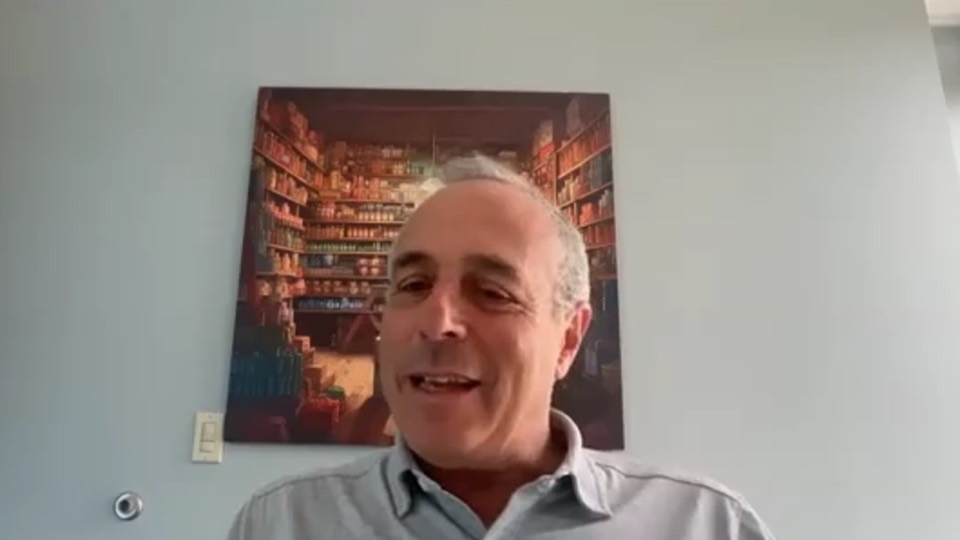
David Greschler, CEO & Co-Founder, NomadGo, is the guest on episode 33 of the Restaurant Tech Trends podcast, hosted by Justin Foster.
 Play episode
What David and Justin discuss
- Why vision AI and spatial vision are not the same thing, and why a 3D understanding of the world is so crucial to achieving accurate inventory counts for restaurant operators
- Why David believes some of the best technologies are those that go deep to capture the minutiae and the edge cases. I agree.
- The best way to measure accuracy of tech products. HINT: it has nothing to do with how the vendor does it.
Also in this episode
- David likely disagrees with Leon Davoyan, EMBA on the most important question of this interview: What is the most over-ordered condiment in America?
Episode notes from the host
This may very well be my favorite Restaurant Tech Trends podcast episode to date.
Not because I have such immense respect for David Greschler, CEO and Co-Founder of NomadGo. Nor because his interview was flawless (it was). It's because I'm elated for the NomadGo team to see how all their hard behind-the-scenes work culminated in yesterday's announcement that Starbucks is rolling NomadGo's tech across 11,000+ corporate-owned restaurants!
(note: this episode was recorded last week, before the announcement dropped)
Whether you're on the restaurant side and want to get a sense of why Starbucks partnered with NomadGo, or you're on the tech side and want to get some insights into how to build winning products...
A huge shout out to the entire NomadGo team, and to Starbucks, for what has certainly been an extended collaboration filled with many lessons learned, but one that's led to a bright new opportunity for both companies
Transcript
Full transcript (2,641 words)
Machine-generated transcript; names may be misspelled.
0:00 Hey everyone, welcome to Restaurant Tech Trends, where we explore restaurant technology trends with some of the industry's biggest movers and shakers in a rapid fire short interview format. Today's podcast is produced by Incept AI. Incept AI takes restaurant orders over the phone and in noisy drive-thrus with friendliness and precision. Learn more at Incept.ai. Now for today's guest, I'm joined by David Greschler, who is CEO and co-founder of NomadGo, an AI platform that automates restaurant inventory using on-device spatial vision. Operators report 10x faster inventory counts with up to 99% accuracy, which is pretty incredible. Before NomadGo, David co-founded a company called Softricity, which was acquired by Microsoft. Nice feather in your hat there, David. Today we're going to unpack speed, accuracy, labor savings, and where AI inventory is headed next. David, welcome to the show. Thanks, Justin, and thanks for having me. I'm very glad that you chose to join and appreciate all of your support over the past year.
1:09 First, I'd like to just dive in a little bit about the idea behind NomadGo. I'd like to know, how did you choose to start this company? Did you immediately understand the problem here with inventory or did you just kind of stumble into this? I would love to learn a little bit more about the early days. Sure. Well, like any good entrepreneur, we mostly stumbled into it. But I will say when I was in college, I worked in a retail environment and one of the worst jobs I had there was, you guessed it, counting inventory with my fingers. And it turns out that that problem is all over the world and still happens today. Until NomadGo, there's really been no technology to really help solve this problem. So we found out about it within the food service business by working with one of the largest QSRs, working on a different problem for them. And they saw that we were doing a good job there. And they said, well, have you ever counted cups? And we said, yeah, I guess we could count cups. And the next thing you know, we were counting everything in that store and found out that the problem is immense. That when people count manually there, it's slow, which means you can't do it frequently, which means you don't have good data, fresh data. And it's boring and people hate counting inventory. And so it means you have unhappy employees. So the combination of slow and unpleasant doesn't make for good accuracy. And accuracy is what people need.
2:47 Got it. I'd like to dive a little bit more into just computer vision in general, because I see companies in this space, some are focused on using computer vision to solve a very specific problem, like what you're doing at NomadGo with inventory. And then I've also talked to folks that say, hey, computer vision is actually a platform that's used to solve all sorts of different things. How do you see computer vision in the restaurant QSR space in particular, evolving over, say, the next two to three years? Is this going to be sort of a best of breed world? Or is this going to be something where you have like one computer vision platform that manages all problems that can be solved with computer vision? Well, first, I'm going to say, if computer vision is the answer, and the question is, you know, inventory, then that's not going to work. What we have learned is that computer vision is a great ingredient in the solution. But as you know, we call our technology spatial vision, because only being able to see the front of that shelf, you know, and maybe determining if something's there or out of stock, is not going to work for inventory, you need to know how many items are on that shelf, how many items are in that refrigerator. And the way to do that is to understand the world in 3D. So we combine computer vision with other technologies, including spatial understanding of the 3D world, including augmented reality to give people real time feedback, including on device AI, which means that it's happening in real time, instead of sending imagery up to the cloud. So what I would say is, if you're trying to solve the inventory problem, computer vision is just a small piece of it. And that's what we've learned. Having said that, I think answering your bigger question about computer vision, there's no doubt that computer vision sort of replaces the eyes. And there are many different uses case out there, and many companies out there using it. And in some cases, they don't necessarily need to understand the world in 3D. So perhaps computer vision is good enough. What I will say is, I do not believe there'll be one computer vision company to solve all these problems. Because each of these problems have deep, deep issues that they need to solve deep, deep integration. So like, for instance, we do very deep integrations with back office folks like PAR, you know, we have to connect to understand what stores are online. Inventory changes all the time. So we have to constantly refresh the list of inventory. All that really deep knowledge, I believe is true of all
5:28 the problems out there. So I think what you're going to see is more the best, you know, one for tracking, drive-through, the best one for whatever it is. I don't believe what, you know, it's kind of like saying, well, I'm an internet provider, so I can do every website in the world. That's not going to work. That's not how it works. Yeah, I think I probably tend to agree with you. Of course, no one really has the answer. We'll see how things evolve. But I've had this conversation with you before we talk about the depth of the problems that we're trying to solve, and all of the thousands of little edge cases and the deep understanding you have to have to solve any one of these use cases, whether that's, you know, vision or what we're doing with voice. So anyway, we'll see how it goes. Yeah. I'd like to talk a little bit about how you are measuring success. So you have this claim, 10x higher, faster counts, 99% accuracy. These are pretty heady claims to make. And I'm curious, exactly how are you measuring this? How are you proving it out in the field? And is that like the best that it can get? Or is that a typical result that a client would have that's using NomadGo? So we let our customers validate those numbers. That's the only way you can really do it. And the way they do it is they use our product, and then they actually go back to that shelf or that refrigerator or, you know, make line. And then they do the manual account, which of course takes them 10 times as long.
6:55 But then they can validate that we actually said when there's four milk jugs that there's actually four milk jugs in that row. Because when you know our product is working, it's literally kind of creating a 3D world. If you watch any of our videos, you'll see that. But what it does then is that it turns it into a list. Now that list is enriched with information around, well, where was that, you know, tetra of lemonade? And it might be, as you know, food service, kind of hard to keep it super organized. It might be on three different shelves. So we'll actually say we saw three on shelf one, two on shelf two, and five on shelf three, right? And for a total number. So people can easily then go, and they do this clearly the first few times they're using our product, and they can validate against it and go, well, there really are, you know, whatever, 10 lemonades. Is that actually correct? So validation is super easy because they have the list and they can see it. The second part of this is accuracy. And what we've learned, and this is why fixed cameras are never going to work for inventory, because, you know, first of all, you can't get them into good places. Like, how do you put a camera in a refrigerator? Or, you know, we all know food service, like, it's a mess back there.
8:12 People are, you know, leasing these spaces. They have to accommodate that, right? And so the other thing we learned is, wait, there is a person, because it's 10 times faster, it's okay to put a person behind that screen. And we call this user in the loop, right? Which means that while the person's scanning, we have built tools so they can kind of in real-time validate and make a difference. If we say, oh, there's five milk jugs and there's only four, there are these little paddles where they just, like a video game, you know, make it four. If we're saying it's chai and it's really whatever, you know, coconut milk, they can actually use their voice and change that to coconut milk. And the whole point is, you're using the person, you're already there, and now you can get yourself to 99% accuracy. Because, you know, you not only have NomadGo, you know, done a really good job, but those little edge cases can get added to by the human. Because at the end of the day, what do you care about? Frequent, highly accurate inventory data. That's what matters. It makes sense. Tell me a little bit about how long it takes for restaurant operators to actually start seeing value from using this product. So usually it'll take, you know, two to three weeks to be up and running. What is important though, is there are some major brands out there, folks like Popeyes, Burger Kings, and so on. And we've been working with folks like that, the franchisees and so on. And so we have built solutions that are now ready to go for those major brands. Well, let's pull back and speak more generally about AI in restaurants. I'm curious, what is one trend that you see out there today, or one technology that you think is just really overhyped that you wish operators would just drop or just tell them, hey, you know, this is great, you're trying this, but maybe try again in five years?
10:02 You know, I would take the opposite view. I think that people have not thought enough about how AI can help them. And it doesn't have to deploy it to, you know, all their stores right away. But there, you know, AI is revealing itself to be pretty damn smart. And yeah, at the end of the day, right, I think that there's a misconception, and it's always been around with technology, that, you know, technology will replace people. But really, I see it as a pulley, like CHAPGTP, for me, is like a pulley. It's just like, instead of having to, you know, kind of do this initial push, I'm going to write a proposal or whatever, it gives me that first draft. And then I still bring my intelligence to it. So no, I think we need more smart people like you, Justin, by the way, thinking about how this technology can help make the physical world more efficient. Because that's the challenge. The beautiful thing about restaurants, right? It's the physical world. Like all these people right now with LLMs, a lot of the stuff they're doing is kind of this knowledge world, right? It's two dimensional. It's, hey, do an analysis of the spreadsheet, blah, blah, blah. But like, well, what NomadGo is doing, and to a certain degree, you as well, because you're doing voice, those are photons and atoms, right? And this is the next generation of AI, the stuff you and I are working on, right? It's the physical world. How can you take that, capture it, and, you know, provide data that is useful to both the folks who own these companies and also their customers?
11:36 All right. Well, David, we're almost out of time. So it's time to move on to our rapid fire questions. And for everyone that's out there, David has no idea what these questions are. So let's hear what you've got to say, David. What is the best food to stress test spatial AI vision? Fry bins, sauce cups, chopped lettuce. I'd say, because it's kind of, because chopped lettuce, you have to recognize that it's chopped versus maybe, you know, single layer. So it's, it was a pretty big challenge and now we have it. What is the most over-ordered condiment in America? Ranch, ketchup, or hot sauce? Hot sauce. Hot sauce. Hot sauce. What cooler would you rather run an inventory count in? A walk-in fridge or a walk-in freezer? Well, okay. That's a great one. Because we have heard over and over again from customers around walk-in fridges, how when they were using a pen and paper to write down what they saw, the ink and the pen would freeze. And they hate being in there anyway, right? Like they, sometimes they have to wear jackets. That's actually why they love NomadGo. Because they're like, oh my god, we'd spend like, you know, 20 minutes in there and I'm about, you know, to freeze myself. And, you know, I can get it done in five with NomadGo. So I'm going to say walk-in freezer.
13:06 Plus maybe your iPad makes a little bit of heat, you know, you can keep your hands warm. Okay. Nice and all those, all those CPUs and GPUs heating up. All right. Edge AI or cloud first? Oh, come on.
13:20 Edge AI all the way. Here's why. Okay. Cloud first is like, I mean, cloud supporting, I like. Yeah, send the data up there. But like, I even think you're going to see one day, I mean, Apple's already talking about it. Look, guys, those devices we have in our pocket, they're not just computers, they're data centers. They've got GPUs, CPUs, neural engines, right? This is the cloud. I mean, I've been in computer. My gray hair tells you I've been in computing a long time, right? It's always a mix. It always starts up at the, you know, in the cloud, or we used to call them servers back then. But it always ends up on the edge because economically, it's much better. It doesn't clog your network. And, you know, we just have to figure out a way to make those devices that are on the edge smart, which they are. For some things, not for all things. I think, you know, in the voice space, we're not quite there yet. But I agree with you, it will trend that direction over the years. Oh, yeah. I mean, when you look at these devices that, like I said, are in our pocket, and you just think about how even we've seen it as we've been doing inventory AI over the last four years, how much faster those chips are, it's just all in our favor, right? You know, it will happen.
14:38 Well, I got a few more for you, but we're out of time, unfortunately. So, David, I wanted to thank you for coming on today and joining me. Everyone, David Greschler, CEO and co-founder of NomadGo. Thanks, David. Well, thank you, Justin. This has been fun. I kind of wish you could have asked me more of those rapid fires because they are fun. But okay, we'll do it another time.